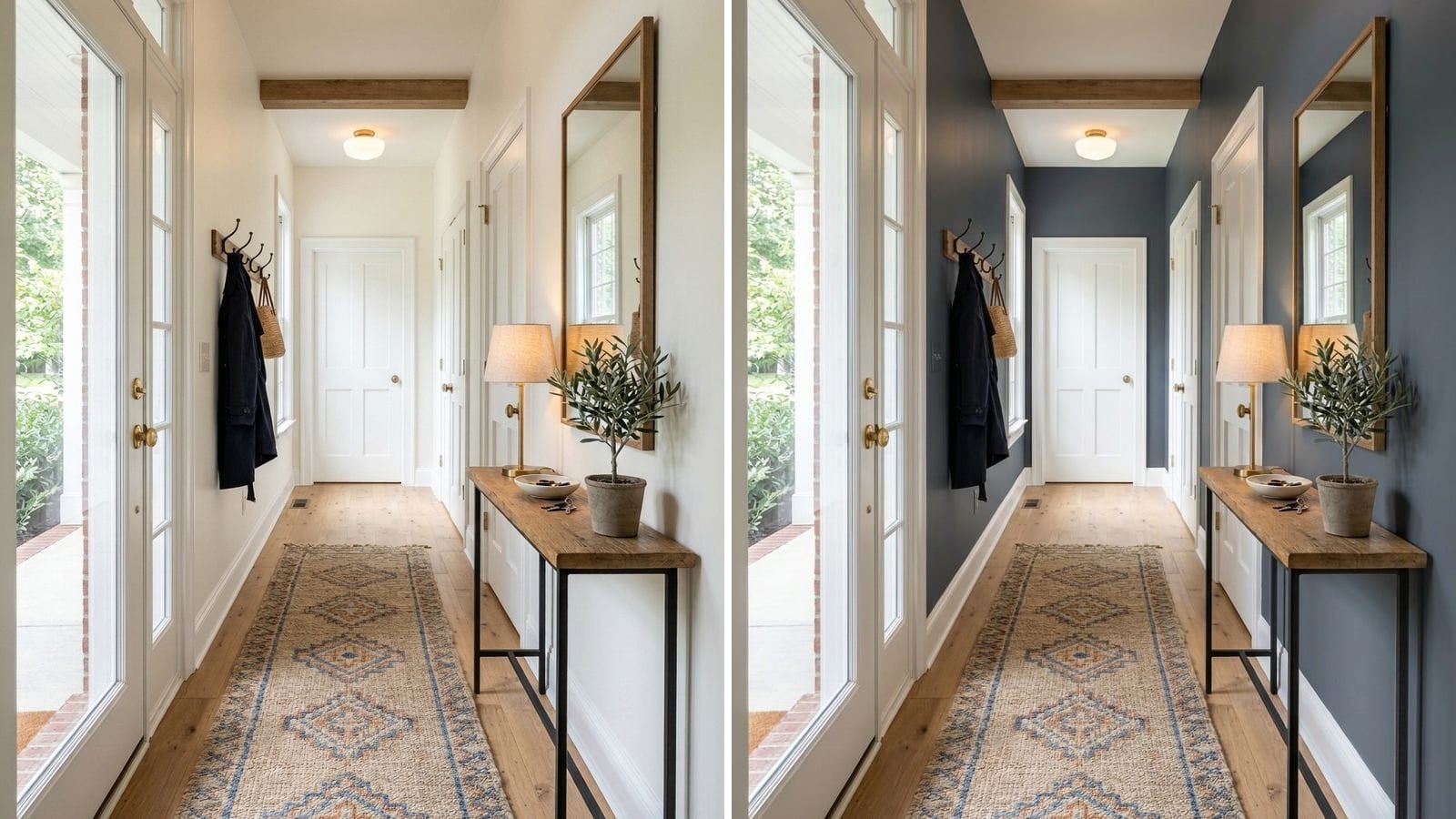
For most hallways, pick a light warm neutral with an LRV between about 55 and 85: a warm white like Sherwin-Williams Alabaster (SW 7008) or a soft greige like Agreeable Gray (SW 7029) or Benjamin Moore Pale Oak (OC-20). Hallways get little daylight of their own and take a beating from hands and bags, so the greige usually ages better than bright white. An entryway you only pass through can go dark, for example Benjamin Moore Hale Navy (HC-154).
Codes, hex values and LRV come from the manufacturers' color data in Muro. The LRV figures below are calculated from the hex value, not quoted from the brand's fan deck, and a hex value is only an approximation on your screen. A sample on your own wall has the final say.
Why hallway colors are harder than they look
A hallway is usually the darkest space in the house that you walk through every day. Often there's no window at all. The light comes in sideways through open doors and from one or two ceiling fixtures, so the same paint looks a shade or two darker and grayer than on the chip. If your hall sits on the north side, the light is also cool, which pulls grays toward blue. We cover that in more detail in paint colors for north-facing rooms.
The second problem is that a hallway is never seen on its own. Stand at the front door and you see the hall, a slice of the living room and maybe the kitchen in one view. A color that looks fine on a swatch can clash with the rooms around it. That's why a lot of people use the hallway as the "glue" color for the whole floor. If you want to plan it that way, the guide to making paint colors flow from room to room walks through it.
And then there's wear. Coats, grocery bags, backpacks, the vacuum, a dog shaking off rain. Hallway walls get touched more than any other walls in the house.
How light should a hallway be?
LRV (light reflectance value) tells you how much light a color bounces back, from 0 for black to 100 for pure white. In a narrow hall with no window, staying roughly between 55 and 85 keeps the space from feeling like a tunnel. Above that, a very bright white can look flat and gray in weak light. Below about 50, a long hall starts to close in. More on reading the number in how LRV affects your paint choice.
The exception is a short entry or foyer with good light from the front door or a sidelight. There you can go much darker, because you don't spend time in it and a deep color makes the first impression of the house feel deliberate.
1. Warm white: brightest and safest
A warm white with a hint of cream reflects the most light without the hospital feel of a cool, bluish white. It suits windowless halls, low ceilings and homes where the hallway connects rooms painted in different colors. The downside is that every fingerprint shows, so it needs a washable finish (more on that below).
| Brand | Color | Code | Hex | LRV (calc.) |
|---|---|---|---|---|
| Sherwin-Williams | Alabaster | SW 7008 | #EDEAE0 | 82.2 |
| Sherwin-Williams | Greek Villa | SW 7551 | #F0ECE2 | 84 |
| Benjamin Moore | Swiss Coffee | OC-45 | #EEECE1 | 83.6 |
| Behr | Whisper White | HDC-MD-08 | #F5F3ED | 89.6 |
Whisper White is the brightest of the four. In a hall with almost no daylight, it may read grayer than you expect, so test it next to Alabaster.
2. Light greige: the best all-rounder for busy halls
Greige sits between beige and gray, and in a hallway it does two jobs. It still reflects plenty of light, and it hides scuffs and everyday dust much better than white. It also bridges warm and cool rooms, which makes it the most common pick for an open hallway that connects a kitchen, living room and stairs. If you like this direction, the full list is in the best greige paint colors.
| Brand | Color | Code | Hex | LRV (calc.) |
|---|---|---|---|---|
| Benjamin Moore | Pale Oak | OC-20 | #DDD9CE | 69.5 |
| Benjamin Moore | Edgecomb Gray | HC-173 | #D9D3C4 | 65.3 |
| Sherwin-Williams | Agreeable Gray | SW 7029 | #D1CBC1 | 60.1 |
| Benjamin Moore | Revere Pewter | HC-172 | #CBC6B8 | 56.5 |
| Behr | Sculptor Clay | PPU5-08 | #CCC3B6 | 55.2 |
Pale Oak is the lightest and works in long, dim halls. Revere Pewter and Sculptor Clay are a step deeper. Save them for halls that get some light from a window or a glass front door.
3. Soft green-gray and blue-green: color without the gloom
If you want the hall to have some personality but still feel light, look at pale green-grays and soft blue-greens. They read as calm and clean, and under warm bulbs they stay soft. They look good with white trim, wood floors and black hardware. Farrow & Ball Mizzle is the deepest one here, so it fits a hall with a window better than a windowless corridor.
| Brand | Color | Code | Hex | LRV (calc.) |
|---|---|---|---|---|
| Sherwin-Williams | Sea Salt | SW 6204 | #CDD2CA | 63.3 |
| Benjamin Moore | Palladian Blue | HC-144 | #C1D1C9 | 61.2 |
| Sherwin-Williams | Rainwashed | SW 6211 | #C2CDC5 | 59.2 |
| Farrow & Ball | Mizzle | 266 | #C0C2B3 | 53 |
Cool light from a north-facing window can push these toward plain blue. Check them in the evening too, under your own fixtures.
4. Dark and dramatic: entryways, foyers and mudrooms
A dark entry works because you see it for a few seconds at a time, often with the front door open and daylight pouring in. Navy, charcoal and deep bronze make a small foyer feel finished and they don't show muddy splashes the way white does. Keep the next room light, so the dark entry reads as a choice and not as a cave. If you're painting the front door too, our front door color guide covers pairings from the outside.
| Brand | Color | Code | Hex | LRV (calc.) |
|---|---|---|---|---|
| Benjamin Moore | Hale Navy | HC-154 | #434B56 | 6.9 |
| Farrow & Ball | Hague Blue | 30 | #3D4E57 | 7.1 |
| Sherwin-Williams | Urbane Bronze | SW 7048 | #54504A | 8.1 |
| Sherwin-Williams | Iron Ore | SW 7069 | #434341 | 5.6 |
| Behr | Very Navy | M500-7 | #233B5E | 4.3 |
Not ready to paint the whole entry dark? Try it below a chair rail or on wainscoting, with a light greige above. You get the scuff protection where bags and shoes hit the wall and keep the upper half bright.
Which finish holds up in a hallway?
Color is half the decision. The other half is sheen. Benjamin Moore's guide to choosing a paint finish recommends eggshell for most areas of a home, hallways included, says pearl works for walls in high-traffic areas, and warns against flat paint where walls need frequent cleaning, because rubbing it can leave shiny patches. In practice, eggshell is the default for hallway walls, and pearl or satin makes sense on the lower half if kids or pets keep marking it. Our paint finish guide explains the trade-offs between sheens.
Hallways also have more doors and trim per square foot than any other room. A clean white on the trim makes a greige or green-gray wall look sharper. The trim paint color guide has whites that work with each of the directions above.
What to avoid in a hallway
- Stark, cool white in a hall with no window. In weak light it turns flat gray and shows every mark.
- Mid-tone grays (LRV around 30 to 50) in a long, dark corridor. They look like concrete and make the hall feel narrower.
- Flat or ultra-matte paint on walls people touch. It's hard to clean without leaving shiny spots.
- A hallway color picked in isolation. Check it against the rooms you can see from it, not just against the chip.
How to check a color before you buy
- Put the sample on the darkest wall of the hall, away from any door or window. That's the worst case.
- Look at it at night with your own ceiling lights on. Most people walk through the hall in the morning and evening, not at noon.
- Stand at the front door and look in. Judge the sample together with the rooms you can see from there.
You can narrow the list before buying samples in Muro. You take a photo of your hallway, pick a real paint by name or code, for example from the tables above, and see it on your own walls. In the iPhone app you can switch between day, sunset and night, with the lights on or off. You can also start in your browser at app.usemuro.com. Once the color is settled, the paint calculator tells you how much to buy.
FAQ
What is the best paint color for a hallway with no windows?
A warm white or light greige with an LRV of roughly 60 to 85, such as Sherwin-Williams Alabaster (SW 7008) or Benjamin Moore Pale Oak (OC-20). They bounce back the little light there is without turning gray.
Should a hallway be lighter or darker than the rooms around it?
Usually the same or a little lighter, because the hall gets less daylight. A short entryway with good light from the door is the exception and can go dark.
What color hides scuffs in a hallway?
A light greige such as Sherwin-Williams Agreeable Gray (SW 7029) or Benjamin Moore Edgecomb Gray (HC-173) hides everyday marks better than white. Pair it with an eggshell or pearl finish so you can wipe the walls.
What is a good dark color for an entryway?
Benjamin Moore Hale Navy (HC-154), Farrow & Ball Hague Blue (30) or Sherwin-Williams Urbane Bronze (SW 7048). Keep the rooms beyond the entry lighter.
What paint finish is best for a hallway?
Eggshell for most hallway walls. Benjamin Moore recommends eggshell for hallways and pearl for high-traffic walls, and advises against flat paint where walls need regular cleaning.