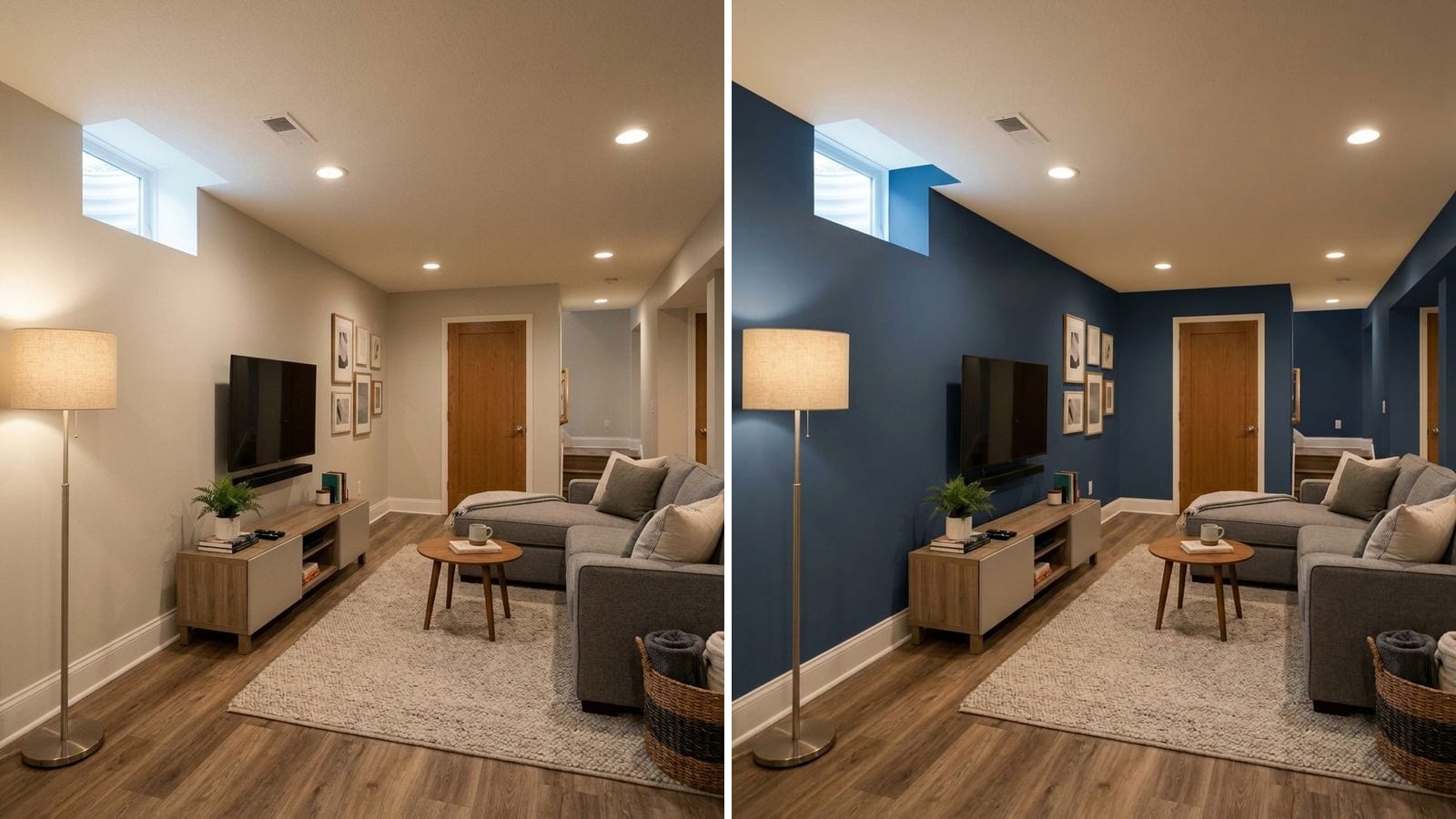
The best basement paint colors are warm, light shades that bounce back the little light you have: warm whites such as Sherwin-Williams Alabaster (SW 7008) or Benjamin Moore Swiss Coffee (OC-45), or a light greige such as Benjamin Moore Pale Oak (OC-20). Skip stark, cool whites and mid-tone grays, which turn flat and gray under basement light. If the space is a media room, do the opposite and go fully dark, for example Sherwin-Williams Naval (SW 6244).
A basement is the hardest room in the house to pick a color for. There is little or no daylight, the lights you choose do most of the work, and the walls can be damp. Below are four directions that work, with real paints. Codes, hex values and LRV come from the manufacturers' color data in Muro. LRV in the tables is calculated from the hex value, not published by the manufacturer. A screen only approximates a color, so a sample on your own basement wall has the final say.
Why basement colors look different
Paint reads differently below ground for three reasons. First, there is little daylight: window wells and small hopper windows let in a thin slice of light, often from one side, so colors look darker and grayer than on the chip, much as they do in north-facing rooms. Second, your bulbs decide what the walls look like for most of the day. Third, moisture: paint on a damp wall peels and can grow mildew, whatever the color.
That's why LRV (light reflectance value) matters more here than anywhere else. The higher the number, the more light a color sends back into the room. For a basement family room, colors with an LRV of roughly 55 to 85 keep the space bright without looking clinical. For the full explanation, see how LRV affects your paint choice.
Pick the bulbs before the paint
The same wall looks different under different bulbs, so settle the lighting first and test paint under it afterwards.
The US Department of Energy's lighting purchasing guide describes 2,700 K as "warm," 3,000 K as "soft," 3,500 K as "neutral" and 4,100 K as "cool," and recommends sticking to the same color temperature when you replace bulbs, because the difference is noticeable. The same page says ENERGY STAR bulbs must have a color rendering index (CRI) of 80 or more.
For paint, that works out like this. Warm bulbs (2,700–3,000 K) push whites and beiges toward yellow, so pick a white that is only slightly warm, like Alabaster, not a creamy one. Cool bulbs (4,100 K and up) make grays look blue and whites look stark, and warm neutrals hold up better under them. Mixed bulbs in one room make the same wall look like two colors, so use one color temperature throughout.
1. Warm whites: the safe default
A warm white with a high LRV is the simplest way to make a basement feel like part of the house. It reflects the most light and looks clean, without the hospital feel of a bright, blue-leaning white. It suits basements with no windows, low ceilings, playrooms and laundry areas. More whites are in 12 best white paint colors.
| Brand | Color | Code | Hex | LRV (calc.) |
|---|---|---|---|---|
| Sherwin-Williams | Alabaster | SW 7008 | #EDEAE0 | 82.2 |
| Benjamin Moore | Swiss Coffee | OC-45 | #EEECE1 | 83.6 |
| Sherwin-Williams | Greek Villa | SW 7551 | #F0ECE2 | 84.0 |
| Behr | Silky White | PPU7-12 | #EEEBE3 | 83.1 |
2. Light greige and warm beige: cozier, still bright
If white feels too plain, go one step darker into a warm greige. These still reflect a lot of light but give the walls some body, which helps a big, open basement feel less like a box. They work in family rooms, guest suites and basements with carpet or wood-look floors. More greiges are in best greige paint colors.
| Brand | Color | Code | Hex | LRV (calc.) |
|---|---|---|---|---|
| Benjamin Moore | Pale Oak | OC-20 | #DDD9CE | 69.5 |
| Benjamin Moore | Edgecomb Gray | HC-173 | #D9D3C4 | 65.3 |
| Sherwin-Williams | Accessible Beige | SW 7036 | #D1C7B8 | 57.9 |
| Behr | Sculptor Clay | PPU5-08 | #CCC3B6 | 55.2 |
3. Soft green-gray: calm without going cold
A pale green-gray is a good middle ground. It reads as a color, but under warm bulbs it stays soft instead of turning icy like a blue-gray, which makes it a decent pick for a home gym, hobby room or basement office. Evergreen Fog is much deeper (LRV around 30), so keep it for one wall or a well-lit room.
| Brand | Color | Code | Hex | LRV (calc.) |
|---|---|---|---|---|
| Sherwin-Williams | Sea Salt | SW 6204 | #CDD2CA | 63.3 |
| Behr | Dolphin Fin | 790C-3 | #CCD6CA | 65.2 |
| Sherwin-Williams | Evergreen Fog | SW 9130 | #95978A | 30.4 |
4. Go dark on purpose: media rooms and bars
In a room where you want less light, not more, stop fighting the basement. Dark walls absorb light and cut glare on a TV screen, and the room feels enclosed in a good way. This suits home theaters, basement bars and game rooms. If you go dark, go all the way: all four walls, maybe the ceiling too, rather than a single dark accent wall in an otherwise pale room. More dark options are in best black paint colors.
| Brand | Color | Code | Hex | LRV (calc.) |
|---|---|---|---|---|
| Sherwin-Williams | Naval | SW 6244 | #2F3D4C | 4.5 |
| Benjamin Moore | Hale Navy | HC-154 | #434B56 | 6.9 |
| Sherwin-Williams | Urbane Bronze | SW 7048 | #54504A | 8.1 |
| Behr | Cracked Pepper | PPU18-01 | #4F5152 | 8.2 |
Damp walls: fix the moisture before you pick a color
No color survives a wet wall. The EPA's guide to mold and moisture recommends keeping indoor humidity below 60 percent, ideally between 30 and 50 percent, and says plainly: "Do not paint or caulk moldy surfaces." It also notes that paint applied over moldy surfaces is likely to peel. Run a dehumidifier, find and fix the source of the water, clean any mold, and let the wall dry before you paint.
Whether you need a mildew-resistant paint, and which finish holds up best in damp air, is the same question as in a bathroom. We covered it in detail in do you need mold-resistant bathroom paint, including what to do in rooms without a window or a fan.
What to avoid in a basement
Stark, cool whites over the whole space look gray and clinical under little daylight and LED light. Mid-tone grays (LRV around 30–50) on every wall read as concrete in low light, which is exactly what you're trying to hide. A dark accent wall in a pale basement makes a low room feel lower, so go light everywhere or dark everywhere in that room.
Mixed bulb temperatures are the quiet culprit: one 2,700 K lamp next to a 4,100 K ceiling fixture makes your color look different on each wall. And skip painting over damp or moldy walls. The paint won't stay, and the problem is still there.
How to check a basement color before you buy
- Test the sample in the basement, at night, with your bulbs on. That's how you'll see it most of the time.
- Put the sample on the darkest wall, the one farthest from the window, not next to it.
- Compare two or three colors at once, because a single swatch on an old wall is hard to judge.
To narrow the list before buying samples, you can try colors in Muro. Take a photo of your basement, pick a real paint by name or code, for example from the tables above, and see it on your own walls. In the iPhone app you can switch between day, sunset and night with the lights on or off, which is close to how a basement actually lives. You can also start in your browser at app.usemuro.com. When the color is settled, the paint calculator tells you how much to buy.
FAQ
What is the best paint color for a basement with no windows?
A warm white with a high LRV, such as Sherwin-Williams Alabaster (SW 7008) or Benjamin Moore Swiss Coffee (OC-45). They reflect the most light and stay warm under LED bulbs.
Should basement walls be light or dark?
Light, if you want the space to feel bigger and brighter. Dark, if it's a media room or bar where less light is the point. Avoid the middle: mid-tone grays look dull in low light.
What color makes a basement look bigger?
Light colors with an LRV above roughly 60, used on the walls and ceiling: Alabaster (SW 7008), Pale Oak (OC-20) or Sea Salt (SW 6204).
Is gray a good color for a basement?
Mid-tone and cool grays usually aren't: they look like concrete in low light. A light warm greige such as Benjamin Moore Edgecomb Gray (HC-173) works better.
Do I need mold-resistant paint in a basement?
Only if the space stays damp. First get humidity under control (the EPA recommends 30 to 50 percent) and never paint over mold. Our guide to mold-resistant paint explains when the specialty paint is worth it.
What color is best for a basement media room?
A very dark color on all walls, such as Sherwin-Williams Naval (SW 6244) or Urbane Bronze (SW 7048). Dark walls cut glare on the screen.