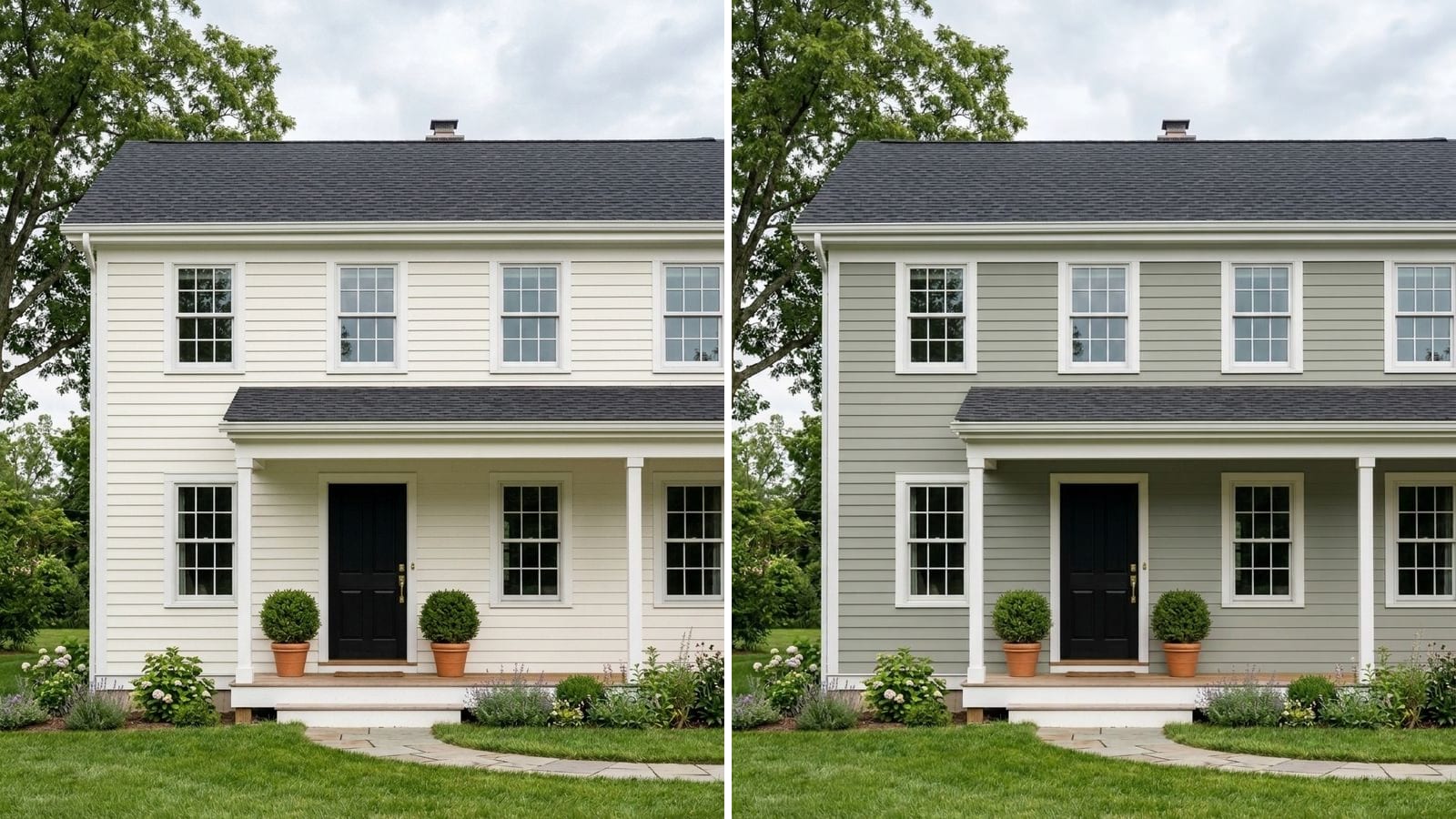
The front door color that works is the one with clear contrast to your siding and the same warmth as your trim and roof. Black and charcoal work on almost any light house. Navy and deep green look good on white, greige and beige. Red is at home on white, gray and blue-gray, and a cheerful yellow only makes sense on a dark gray or navy house. If your house is already dark, a light or wood door stands out better than another dark color.
Below: how to choose, the best paints in each color family, a chart of door colors by house color and the usual mistakes. Names, codes and hex values come from the manufacturers' color data in Muro. A hex value on a screen is only an approximation, and outdoor light changes colors even more than indoor light, so test a sample on the door itself.
How to choose a front door color in three checks
- Contrast with the siding. A door reads from the street when it is clearly darker or clearly lighter than the wall around it. LRV (light reflectance value, 0 to 100) helps: a door with an LRV around 5–10 on siding above 50 usually stands out. A door and siding that sit within a few LRV points of each other merge into one surface. Our guide to LRV explains the number.
- Warm or cool, like the rest. Look at what you can't easily change: roof, brick, stone, gutters, window frames. A warm brown roof and tan stone suit warm reds, bronzes and greens. A charcoal roof and white vinyl windows suit black, navy and cooler reds.
- Light on the door. A door facing south or west gets direct afternoon sun, which brightens and warms the color. A door under a deep porch roof sits in shade and looks darker than the chip. Why this happens is covered in why paint looks different on the wall than on the chip.
Black and charcoal: works on almost any light house
This is the safe pick. A black door looks sharp on white, greige, sage and light gray, and it goes with black hardware, lights and house numbers. Charcoal is a bit softer, and it hides dust and fingerprints better than true black. The full exterior picture is in white house with black trim.
| Brand | Color | Code | Hex | LRV (calc.) |
|---|---|---|---|---|
| Sherwin-Williams | Tricorn Black | SW 6258 | #2F2F30 | 2.9 |
| Benjamin Moore | Black Beauty | 2128-10 | #393736 | 3.9 |
| Sherwin-Williams | Iron Ore | SW 7069 | #434341 | 5.6 |
| Benjamin Moore | Wrought Iron | 2124-10 | #494A4B | 6.8 |
Navy and deep blue
Navy is the traditional alternative to black. It looks dressy on white and cream houses and softer than black on greige. Some navies lean gray, and those are easier to pair with gray siding.
| Brand | Color | Code | Hex | LRV (calc.) |
|---|---|---|---|---|
| Benjamin Moore | Hale Navy | HC-154 | #434B56 | 6.9 |
| Sherwin-Williams | Naval | SW 6244 | #2F3D4C | 4.5 |
| Benjamin Moore | Gentleman's Gray | 2062-20 | #304656 | 5.7 |
| Benjamin Moore | Van Deusen Blue | HC-156 | #485B6E | 10 |
If your store carries Valspar, Royal Navy (4011-4) is a near twin of Hale Navy at ΔE 0.64.
Red and oxblood
A red door gets noticed from the street before anything else on the house. Bright reds look fresh on white and cool gray. Deeper brick reds and oxblood go better with beige, sage and a brown or terracotta roof. Skip bright red next to red or orange brick.
| Brand | Color | Code | Hex | LRV (calc.) |
|---|---|---|---|---|
| Benjamin Moore | Caliente | AF-290 | #8A2728 | 7 |
| Benjamin Moore | Heritage Red | HC-181 | #990A14 | 7 |
| Sherwin-Williams | Fired Brick | SW 6335 | #83382A | 7.8 |
| Sherwin-Williams | Rookwood Red | SW 2802 | #622F2D | 4.8 |
Caliente has a close match at Behr: New Brick (S-H-200, ΔE 0.78).
Deep green: quiet, natural, good with wood
From across the street a dark green reads almost black, and the color only shows up close. It sits well on a house surrounded by trees, and next to stone, cedar shingles and brass hardware.
| Brand | Color | Code | Hex | LRV (calc.) |
|---|---|---|---|---|
| Benjamin Moore | Essex Green | HC-188 | #27362E | 3.3 |
| Sherwin-Williams | Roycroft Bottle Green | SW 2847 | #324038 | 4.6 |
| Sherwin-Williams | Jasper | SW 6216 | #343B36 | 4.1 |
| Benjamin Moore | Tarrytown Green | HC-134 | #415752 | 8.5 |
Bronze, yellow and teal: for the right house
Not every door has to be dark. These three cover cases the others don't:
| Brand | Color | Code | Hex | LRV (calc.) | Best on |
|---|---|---|---|---|---|
| Sherwin-Williams | Urbane Bronze | SW 7048 | #54504A | 8.1 | Greige, beige, warm white |
| Benjamin Moore | Hawthorne Yellow | HC-4 | #F5E1A4 | 75.9 | Dark gray, navy, charcoal |
| Sherwin-Williams | Rainstorm | SW 6230 | #244653 | 5.4 | White, light gray, sand |
Urbane Bronze is the softer cousin of black for warm houses. Benjamin Moore's Dragon's Breath (1547) is nearly identical at ΔE 0.65. A pale yellow like Hawthorne Yellow only works when the siding is dark enough to make it glow, so it's the only light door color in this list.
Which front door color goes with your house color?
This chart pairs common siding colors with door colors from the tables above. The rule behind it: a big lightness gap plus matching warmth. For the siding colors themselves, see best exterior house paint colors.
| House color | Code | Hex | Door colors that work |
|---|---|---|---|
| Sherwin-Williams Alabaster | SW 7008 | #EDEAE0 | Tricorn Black, Hale Navy, Caliente, Essex Green |
| Sherwin-Williams Agreeable Gray | SW 7029 | #D1CBC1 | Urbane Bronze, Iron Ore, Hale Navy, Tarrytown Green |
| Sherwin-Williams Accessible Beige | SW 7036 | #D1C7B8 | Rookwood Red, Tarrytown Green, Urbane Bronze |
| Sherwin-Williams Evergreen Fog | SW 9130 | #95978A | Tricorn Black, Fired Brick, natural wood |
| Benjamin Moore Boothbay Gray | HC-165 | #AAB2B0 | Heritage Red, Tricorn Black, Hawthorne Yellow |
| Sherwin-Williams Gauntlet Gray | SW 7019 | #78736E | Caliente, Hawthorne Yellow, natural wood |
| Benjamin Moore Hale Navy (body) | HC-154 | #434B56 | Hawthorne Yellow, Heritage Red, natural wood |
A natural wood door works with almost all of these, as long as its tone matches the warmth of the house: honey and cedar tones with warm siding, darker walnut and gray-brown stains with cool siding.
If you are thinking about resale, we looked at what the data says about exterior colors and home value, including door colors.
Paint and finish for a front door
- Use exterior paint made for doors and trim. It handles sun, rain and constant handling better than interior paint.
- Pick a sheen with some gloss. Benjamin Moore says high gloss is easy to clean and "will add a stunning look to doors," but it also notes that gloss accentuates blemishes. On an older, dented door, semi-gloss or satin is kinder.
- Dark doors get hot. Dark colors have a low LRV, which means they reflect little light and absorb the rest as heat. A very dark door in full afternoon sun can get properly hot, especially behind a full-glass storm door. If that's your door, check your door maker's care and warranty notes before you go dark.
What to avoid
- A door in the same lightness as the siding. Gray door on gray siding disappears, even if the hues differ.
- Fighting the fixed elements. A cool fire-engine red next to orange brick, or a warm yellow under a blue-gray roof, rarely works.
- Too many accent colors. Door, shutters and trim all in different strong colors fight each other. Let the door be the loud one and keep the rest quiet.
- Judging the color on the porch in shade at noon. Look at the door in morning and evening light from the street, where people actually see it.
- A tiny sample. Paint at least a 2-foot patch on the door or a board you hold against it.
How to check a color before you buy
- Paint the sample on the door or tape a painted board to it, then step back to the sidewalk.
- Look at it in the morning, at midday and in the evening. Outdoor light shifts a lot more than indoor light.
- Compare two or three candidates at once, for example black, navy and one red.
To narrow the list before you buy sample pots, you can try front door and siding colors in Muro. Take a photo of your house, pick a real paint by name or code (the tables above work as a shortlist) and see it on your own facade. In the iPhone app you can see the house by day, at sunset and at night. You can also start in your browser at app.usemuro.com. The screen is an approximation, so the final check is a sample on the real door.
FAQ
What is the safest front door color?
Black and charcoal are the safest picks, because they contrast with almost any light siding, for example Tricorn Black SW 6258 or Black Beauty 2128-10 by Benjamin Moore. Navy, deep green and red are the classic alternatives.
What color front door goes with a white house?
Almost any strong color: black (Tricorn Black SW 6258), navy (Hale Navy HC-154), red (Caliente AF-290) or deep green (Essex Green HC-188). Match warmth to the trim and roof.
What color front door goes with a gray house?
On light gray, black, navy or a clear red. On mid or dark gray, such as Gauntlet Gray SW 7019, a red like Caliente AF-290, a pale yellow like Hawthorne Yellow HC-4 or a natural wood door stands out better than another dark color.
What color front door goes with a beige or tan house?
Warm, deep colors: oxblood like Rookwood Red SW 2802, deep green like Tarrytown Green HC-134 or bronze like Urbane Bronze SW 7048.
Should the front door match the shutters?
It can, and that's the easiest way to make the house look pulled together. If they differ, keep the shutters quieter, for example black shutters with a red door. Shutters on brick are covered in trim, door and shutter colors for a brick house.
Should a front door be glossy?
Usually yes, at least semi-gloss. Gloss is easy to clean and makes the door look finished. On a dented or older door, satin hides flaws better.