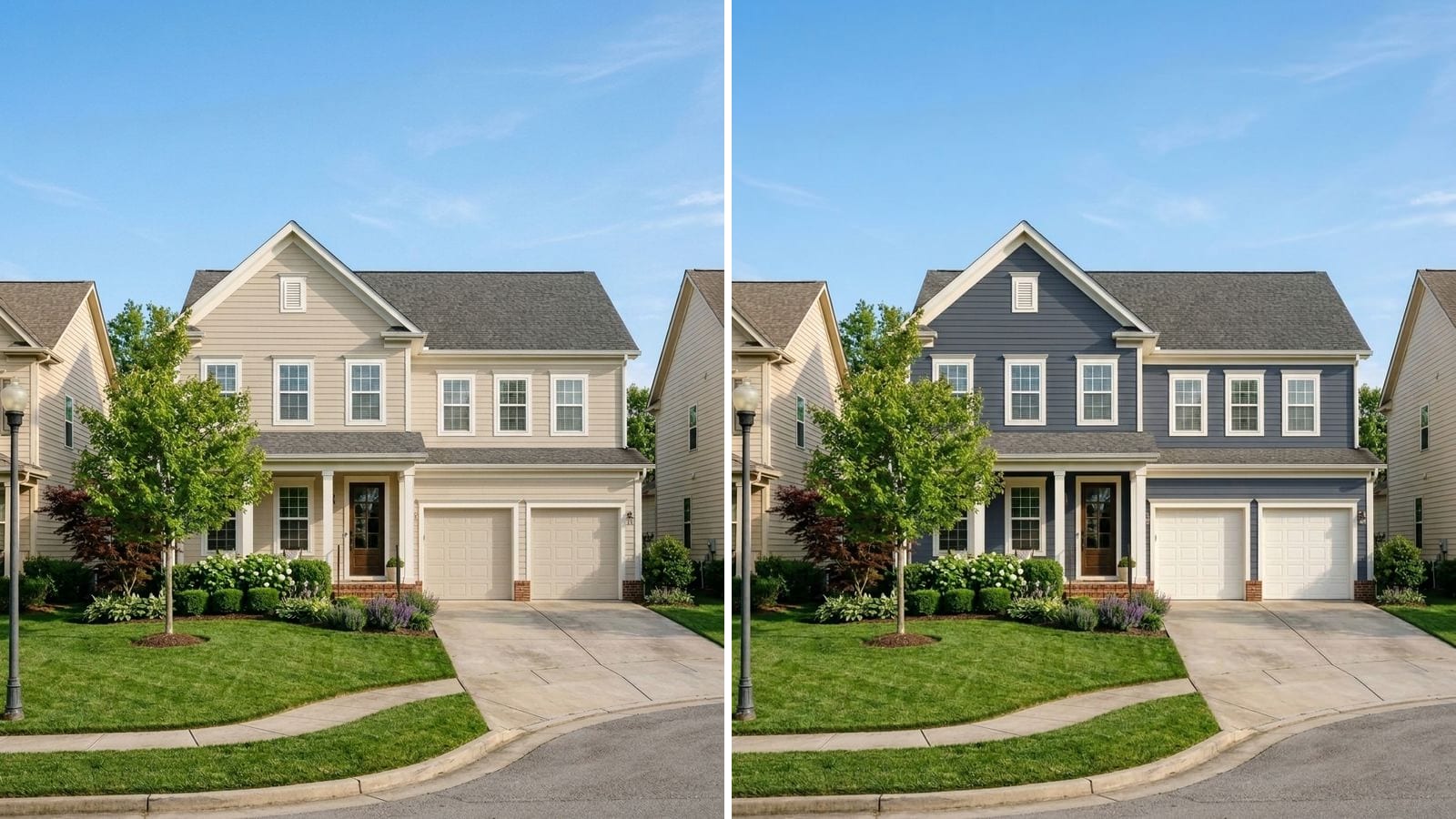
To get your HOA to approve an exterior paint color, pick from the community's approved palette if it has one, and submit an application that names the brand, color name and code for the body, trim, door and any shutters, plus the sheen. Add photos of your house and the two neighbors' houses, and wait for the written approval before anyone opens a can.
Below is what architectural committees look at, what to put in the form, and what a few states require from the HOA if it says no. Codes, hex values and LRV come from the manufacturers' color data in Muro. A hex value on your screen is an approximation, and outdoors the sun shifts colors even more, so a large sample on your own siding is what you should judge.
What does the HOA actually review?
Your CC&Rs (the recorded declaration) say which changes need approval. A separate document, usually called architectural or design guidelines, says how. The body that decides goes by different names: architectural review committee (ARC), architectural review board, modifications committee, or simply the board.
Read both before you choose anything. Look for:
- Is there an approved palette? Some communities allow only listed colors.
- Does repainting in the same color need approval? In some communities it does.
- How many colors per house and which parts count as body, trim and accent.
- Sheen limits and rules about your neighbors' colors.
A real example shows how specific this gets. The Westchase Community Association in Florida says all exterior painting and repainting must be submitted for approval and only palette colors are permitted. It allows two or three colors per house (up to five with shutters and a faux-wood garage), caps the body sheen at semi-gloss, and requires trim to sit within three shades of the body on the same Sherwin-Williams strip, or be one of the trim-only colors. Your community's rules will differ, which is the point of reading them first.
Start from the palette, then pick your brand
Palettes are often published as one brand's colors, very often Sherwin-Williams. That doesn't always mean you must buy that brand. The Westchase guideline, for example, says any manufacturer may be used as long as the color is matched to the approved Sherwin-Williams color. If your guidelines allow this, write both on the form: the palette color and the paint you will actually buy.
Here are close matches from Muro's data for a few palette-style neutrals. ΔE measures the color difference; Muro calls anything under 1 practically identical.
| Palette color | Code | Hex | Closest match | Code | Hex | ΔE |
|---|---|---|---|---|---|---|
| Agreeable Gray | SW 7029 | #D1CBC1 | Benjamin Moore Collingwood | 859 | #D3CEC4 | 0.85 |
| Accessible Beige | SW 7036 | #D1C7B8 | Behr Shoreline Haze | MQ6-31 | #D0C7B8 | 0.50 |
| Requisite Gray | SW 7023 | #B9B2A9 | Benjamin Moore Silver Fox | 2108-50 | #B8B1A7 | 0.58 |
| Alabaster | SW 7008 | #EDEAE0 | Benjamin Moore Dune White | 968 | #ECEAE0 | 0.50 |
| Urbane Bronze | SW 7048 | #54504A | Benjamin Moore Dragon's Breath | 1547 | #55514A | 0.65 |
Benjamin Moore Collingwood is the closest Benjamin Moore match for Agreeable Gray, not the closest in the whole database. For Requisite Gray, Behr Park Avenue (MQ2-55) is also very close at ΔE 0.93. A named color with its own code is easier to defend than a store-mixed match from a chip. More on this in paint color twins across brands.
Which colors are the easiest ask?
We don't know of any published approval rates, so take this as reasoning, not a statistic. Committees judge a color against the street, and a mid-tone warm neutral that already looks like the neighborhood gives them nothing to argue about. A bright or unusual body color can still pass, but expect questions.
A scheme that stays in safe territory:
| Part | Brand | Color | Code | Hex | LRV |
|---|---|---|---|---|---|
| Body | Sherwin-Williams | Accessible Beige | SW 7036 | #D1C7B8 | 57.9 |
| Body (darker) | Sherwin-Williams | Requisite Gray | SW 7023 | #B9B2A9 | 45.0 |
| Body (warmer) | Benjamin Moore | Revere Pewter | HC-172 | #CBC6B8 | 56.5 |
| Trim | Sherwin-Williams | Alabaster | SW 7008 | #EDEAE0 | 82.2 |
| Door or shutters | Sherwin-Williams | Urbane Bronze | SW 7048 | #54504A | 8.1 |
| Door (color) | Benjamin Moore | Hale Navy | HC-154 | #434B56 | 6.9 |
LRV here is calculated from the hex value, not taken from the chip. It still tells you something useful: a trim at 82 against a body at 45–58 reads clearly from the street, and a door under 10 stands out from both. For more body colors by style, see best exterior house colors, and for door ideas, front door colors.
What to put in the application
A committee can only approve what it can identify. "Light gray with white trim" can't be approved, because it could be a hundred colors. Give them this:
- Every surface, one line each: body, trim, front door, shutters, garage door. For each: brand, color name, code, sheen and product line (for example, Sherwin-Williams Accessible Beige SW 7036, satin).
- Physical chips or a sample board if the form asks for them. Some committees want to see the color outdoors.
- A current photo of the front of your house and photos of the houses on both sides and across the street, with their colors if you know them.
- A picture of the proposal. A photo of your own house in the new colors answers the question every committee member is quietly asking: what will this look like on the street?
Keep a copy of everything and get the approval in writing.
Will your neighbor's color block yours?
It can. The Westchase guidelines say body colors may not be in the same color range as adjacent homes or the house directly across the street, with at least two strips between them on the Sherwin-Williams deck, and two neighboring houses can't both use the approved whites. If your rules have something like this, find out what the houses next to you and across the street are painted before you fall for a color.
What happens if the HOA says no?
That depends on your documents and your state. Three state examples, shortened. Read the full text or ask a lawyer before you rely on any of it.
- California. Under Civil Code § 4765, decisions on proposed changes must be made in good faith, can't be unreasonable, arbitrary or capricious, and must be in writing. A denial has to explain why and how to ask for reconsideration, and if a committee denied it, you can generally get reconsideration by the board at an open meeting. The procedure must also state the maximum time the association has to respond.
- Texas. In associations with more than 40 lots, Property Code § 209.00505 requires a denial notice that describes the basis in reasonable detail and the changes needed for approval. You may request a board hearing within 30 days after the notice was mailed, and the board must hold it within 30 days of receiving your request.
- Florida. Under § 720.3035, an HOA's review authority reaches only as far as the declaration or published guidelines state or reasonably imply, and the standards must be applied evenly. A denial must be in writing and name the specific rule or covenant and the part of your plan that doesn't conform. If the declaration offers options, the HOA can't restrict your choice among them.
In practice, a denial that names a rule tells you what to change. Swap the color for one on the palette or one that differs more from your neighbors, and resubmit.
What to avoid
- Painting first and asking later. You lose your bargaining position, and the documents decide whether the color stays.
- Describing colors instead of naming them. "Greige" is not a color, SW 7036 is.
- Forgetting the small parts. Garage doors, shutters, gutters and the front door often count as trim or accent and need a line on the form.
- Judging from a 2-inch chip indoors. Outside, in full sun, mid-tones look lighter than on the chip.
- Assuming the old color is grandfathered. In Westchase, a body color no longer on the palette may be kept only on a home addition; a full repaint has to come from the current palette.
How to check a color before you buy
Paint two large samples on the house, one on a sunny wall and one in shade, and look at them from the street at noon and late afternoon. To narrow the list first, and to have a picture for the application, take a photo of your house from the street in Muro, pick the real paint by name or code from the palette, and see it on your own siding. The iPhone app shows the house by day, at sunset and at night, and you can start in your browser at app.usemuro.com. After approval, the paint calculator tells you how many gallons to order.
FAQ
Do I need HOA approval to repaint my house the same color?
Check your guidelines. Some communities require an application for any exterior repaint, even the same color. Westchase in Florida, for example, requires approval for all exterior painting and repainting.
How long does HOA paint approval take?
It depends on your documents and how often the committee meets. In California the association's procedure must state the maximum response time, so check your guidelines for that number.
Can I use a different paint brand than the HOA palette?
Sometimes. Some guidelines allow any brand matched to the palette color. Name both on the form, for example Sherwin-Williams Accessible Beige (SW 7036) bought as Behr Shoreline Haze (MQ6-31), ΔE 0.50.
Can my HOA deny a color without a reason?
In several states it can't. California, Texas (associations over 40 lots) and Florida require a written denial with the reason; Florida also requires the specific rule it relies on.
What should I include in an HOA paint application?
Brand, color name, code and sheen for every painted surface, photos of your house and the neighbors' houses, chips or samples if requested, and ideally a picture of your house in the proposed colors.