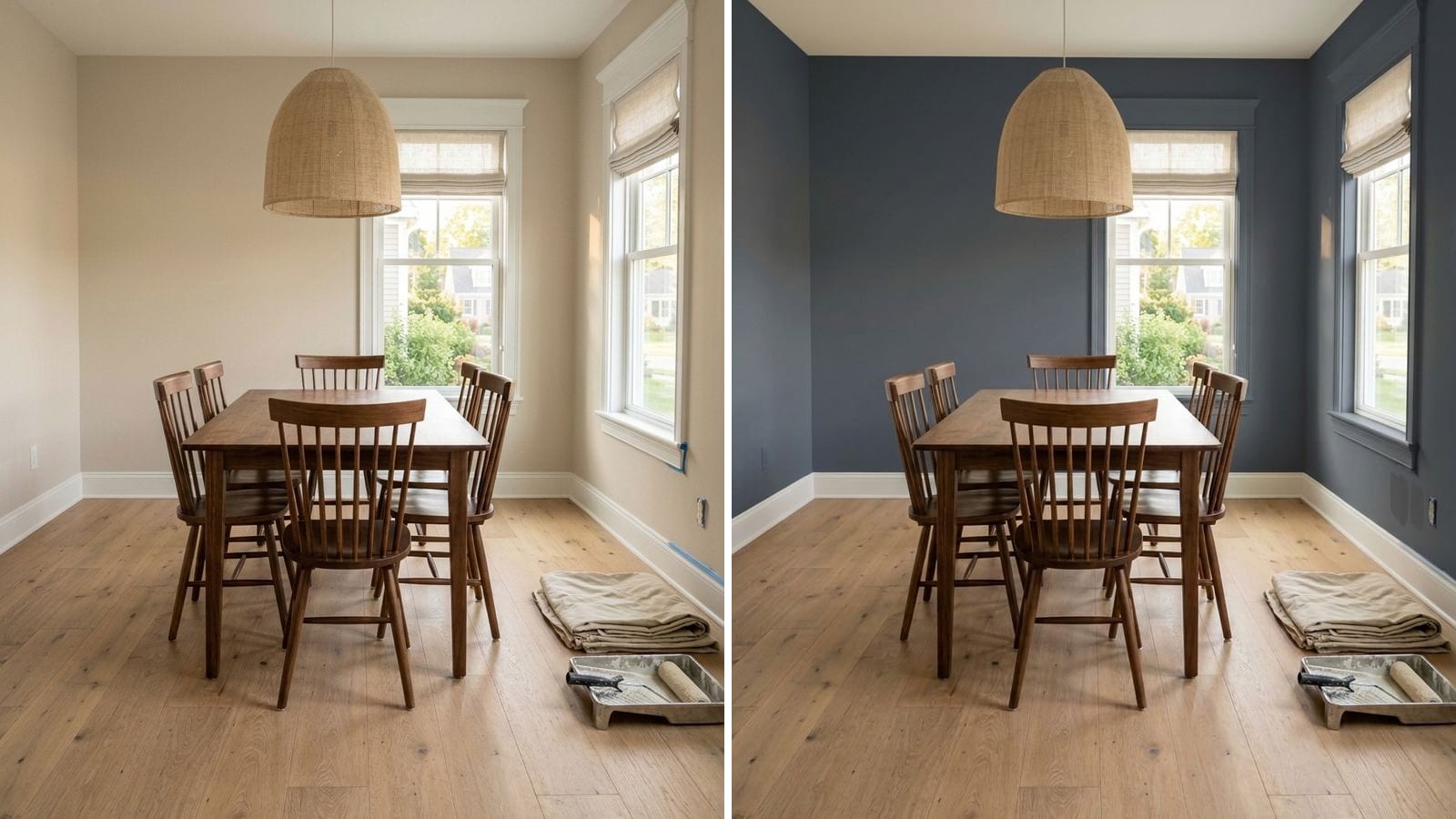
Painters win more bids when they take the color risk off the customer's plate at the estimate. Photograph the room, show the customer their own walls in two or three candidate colors before you leave, and write the chosen paint's brand, name and code into the bid. That gives them a reason to choose you that isn't the lowest price.
This guide is for owners of residential painting companies in the US. It covers what to show, which color decisions stall most jobs, and what to write into the bid so the color you agreed on is the color that gets mixed. Codes, hex values and LRV come from the manufacturers' color data in Muro. A screen is only an approximation, and a sample on the wall still has the final say, so say that to the customer too.
Why the color question decides the bid
Most homeowners can't judge your prep work, your coverage rate or your caulk lines from a quote. What they can judge is how the visit felt. What scares them most about a repaint is picking a color, paying for it and hating it by day two. The price comes second.
If your bid answers that fear, you're no longer one of four similar numbers. You're the crew that showed them the living room in Accessible Beige and in Agreeable Gray, and helped them choose. That's a reason to pick you that has nothing to do with being the cheapest.
It also protects your margin after you win. A customer who says "it's darker than I thought" after the first coat costs you a second coat you never priced. If you want the numbers side of that, see how to price interior painting jobs.
What "showing the color first" means at the estimate
No mood board, no stock photo of someone else's living room. Three things:
- Their room. A photo of the actual wall, taken at the estimate, in the light that room really has. A north-facing den looks different from a south-facing kitchen, and the customer knows their room.
- Two or three real paints. Colors with a brand and a code, not "a soft gray". If you want a framework for narrowing to three, we covered it in how to present paint color options to clients.
- A decision before you leave. The customer compares the options on their own wall with you in the room, not a week later after a trip to the store for samples.
Then you back it up with a physical sample on the wall before the job. The picture narrows the choice; the sample confirms it. How to run the color conversation itself is in how to run and charge for a color consultation.
The color decisions that stall the most jobs
Customers rarely choose between twenty colors. They get stuck between two that look almost the same on a chip. Know these pairs and what actually separates them.
| Brand | Color | Code | Hex | LRV (calc.) |
|---|---|---|---|---|
| Sherwin-Williams | Agreeable Gray | SW 7029 | #D1CBC1 | 60.1 |
| Sherwin-Williams | Repose Gray | SW 7015 | #CCC9C0 | 58.4 |
| Sherwin-Williams | Accessible Beige | SW 7036 | #D1C7B8 | 57.9 |
| Benjamin Moore | Revere Pewter | HC-172 | #CBC6B8 | 56.5 |
| Sherwin-Williams | Alabaster | SW 7008 | #EDEAE0 | 82.2 |
| Sherwin-Williams | Pure White | SW 7005 | #EDECE6 | 83.7 |
| Benjamin Moore | Hale Navy | HC-154 | #434B56 | 6.9 |
| Sherwin-Williams | Naval | SW 6244 | #2F3D4C | 4.5 |
How to explain the pairs in one sentence each:
- Agreeable Gray vs Repose Gray: nearly the same lightness. Agreeable Gray is a touch warmer; Repose Gray is the cooler, grayer one. We went deeper in the Agreeable Gray review.
- Accessible Beige vs Revere Pewter: both warm greige. Accessible Beige leans more beige; Revere Pewter is a little darker and less yellow.
- Alabaster vs Pure White: Alabaster is the creamier white, Pure White the cleaner one. On trim next to warm walls, that difference shows.
- Hale Navy vs Naval: Naval is darker (LRV 4.5 vs 6.9) and bluer. Hale Navy is the grayer of the two.
Put the code in the bid, not just the name
Color names repeat across brands. Codes don't. Sherwin-Williams has Pure White (SW 7005, #EDECE6), and RAL has a different Pure white (RAL 9010, #F1EDE1). If your bid says "Pure White", someone at the counter has to guess.
For every room and surface, the color section of the bid should list:
- Brand, color name and code, for example Benjamin Moore Hale Navy HC-154.
- Product line and sheen, because the same color reads differently in flat and in satin. Our paint finish guide has the trade-offs.
- Number of coats.
- A sign-off line: "Color approved from sample on the wall on [date]."
- What happens if the color changes after the first coat: it's a change order, priced like any other.
If the customer's color comes from a brand your supplier doesn't carry, you can order a near twin by code. ΔE measures how far apart two colors are: the lower the number, the closer the match.
| Specified | Twin you can order | Code | ΔE |
|---|---|---|---|
| Agreeable Gray SW 7029 | Benjamin Moore Collingwood | 859 | 0.85 |
| Accessible Beige SW 7036 | Behr Shoreline Haze | MQ6-31 | 0.5 |
| Revere Pewter HC-172 | Sherwin-Williams Useful Gray | SW 7050 | 1.1 |
| Alabaster SW 7008 | Benjamin Moore Dune White | 968 | 0.5 |
| Hale Navy HC-154 | Valspar Royal Navy | 4011-4 | 0.64 |
| Naval SW 6244 | Benjamin Moore North Sea | CC-932 | 1.18 |
Tell the customer it's a match from a different brand, and paint a sample of the twin before the job. A twin with a low ΔE is close, but it's still a different formula. How the sample options compare is in peel-and-stick samples vs sample pots vs an app.
What to avoid at the estimate
- Showing ten colors. A long list sends the customer back to square one. Two or three, chosen for the room.
- Judging colors under store lighting. The chip in the store and the wall at home are lit differently. Show the color in the customer's room.
- Promising that the screen shows the final color. Phones, sheen and tinting all shift what people see. Say "this gets us to the right color; the sample confirms it".
- Writing only the color name. See above. Name plus code, every time.
- Skipping the sample because the picture looked good. Sign-off happens on the wall.
How to check a color before you buy
At the estimate, take a photo of the wall in the light the room really has. In Muro you pick real paints by name or code, up to twelve colors in one batch, and the customer swipes between before and after on their own room while you're still there. In the iPhone app you can also show the room by day, at sunset and at night. The web app at app.usemuro.com runs on Android and on a laptop, on the same account. For crews there's a Business plan with 3 seats and a shared pool of 400 color changes a month. One honest limit: for Sherwin-Williams the app currently shows names and hex values, not codes, so add the SW code to the bid yourself.
Once the color is settled, the paint calculator gives you the gallons. And if you're still building your toolkit, our painter's tech stack covers estimating, scheduling and the rest.
FAQ
How do painting contractors win more bids?
Answer the question the customer worries about most: what the room will look like. Show their own room in two or three real paints at the estimate, help them choose, and put the brand, name and code into the bid.
Should I include the paint color in my painting estimate?
Yes. List brand, color name, code, product line, sheen and number of coats for each room, for example Benjamin Moore Hale Navy HC-154 in eggshell, two coats. It prevents mix-ups at the counter and disputes after the job.
What if the customer changes the color after the first coat?
Treat it as a change order and say so in the bid. A sign-off line such as "Color approved from sample on the wall on [date]" makes that conversation much easier.
Which gray do customers usually choose between?
Agreeable Gray (SW 7029) and Repose Gray (SW 7015) are a common pair. They're nearly the same lightness; Agreeable Gray is a little warmer, Repose Gray a little cooler.
Can I swap a Benjamin Moore color for a Sherwin-Williams one?
Often, with a close twin. Revere Pewter (HC-172) has Sherwin-Williams Useful Gray (SW 7050) at ΔE 1.1. Paint a sample of the twin first and tell the customer it's a match from another brand.
Do color visualizer apps replace paint samples?
No. They help the customer narrow down to one or two colors on their own walls. A sample on the wall confirms the final choice before you order.