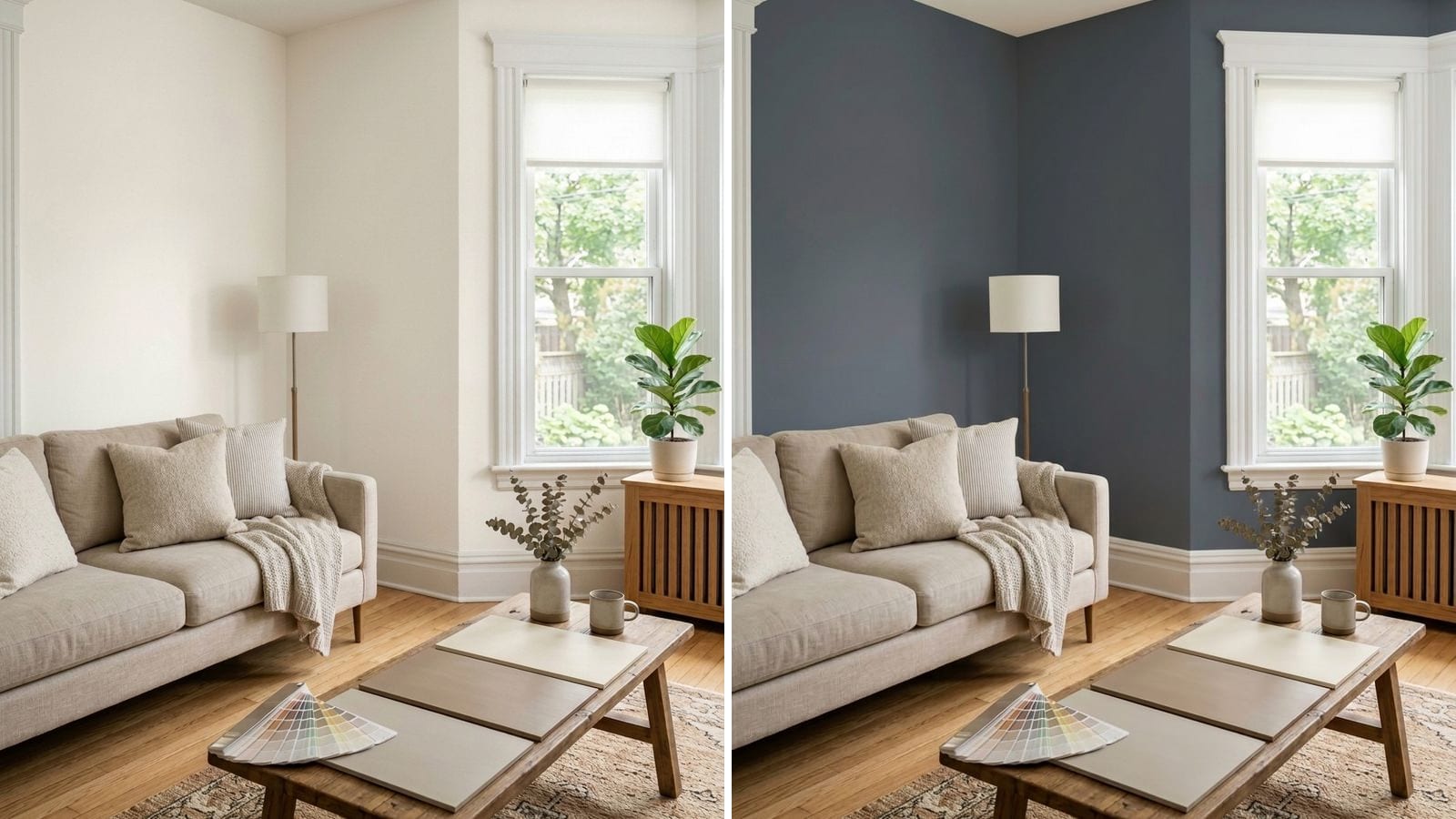
A color consultation from a painter is a short, scoped session that ends with a written color schedule: every surface, with brand, color name, code and sheen. Charge for it as a flat fee that you credit back if the client hires you for the job, or bundle one free session into your estimate with a clear limit. Price it between the free help a paint store gives and the $250 to $300 per hour that premium paint brands charge for their own consultants.
Most homeowners who call a painter haven't picked colors yet, and the job stalls until they do. A consultation turns that delay into a paid step with a clear end. Below: how to set the price, run the session and hand over something the client can sign. Codes, hex values and LRV come from the manufacturers' color data in Muro. A hex value on a screen is only an approximation, so a painted sample on the wall makes the final call. Prices below were checked on November 16, 2026.
What do color consultations cost in the US?
The paint brands publish their own prices, which gives you real anchors instead of guesses:
| Who | Format | Price | Source |
|---|---|---|---|
| Benjamin Moore | 30-minute Zoom, one interior room, 5 mailed swatches | $50 | benjaminmoore.com |
| Benjamin Moore | 45-minute Zoom, one exterior, 8 mailed swatches | $60 | benjaminmoore.com |
| Benjamin Moore | Add-on: one photo rendered in three schemes | $30 | benjaminmoore.com |
| Farrow & Ball | Virtual, with a Colour Expert | from $250 per hour | farrow-ball.com |
| Farrow & Ball | In-home, with a Colour Expert | from $300 per hour | farrow-ball.com |
| Dunn-Edwards | In-store consultation with a paint advisor | free | dunnedwards.com |
Independent consultants near you list their rates on Thumbtack and Angi, and those vary a lot by city. Check two or three local listings before you set your number. You are competing with them, not with the national average.
What you have that the brands don't: you're standing in the room, you can see the floors, the trim and the light, and you know how the paint will go on. That's worth more than a 30-minute video call, though less than a designer who also picks the sofa.
Three ways to charge, and when each one works
1. Free, inside the estimate. One visit, colors for the rooms you are bidding on, a written schedule. It works when consultations close jobs for you. Put a limit in writing: one session, up to three options per surface, one round of changes.
2. Flat fee, credited to the job. The client pays upfront and gets the money back as a line item on the invoice if they hire you. It weeds out people who only want free advice, and it pays you if they take your schedule to a cheaper crew. For most painting companies this is the safe default.
3. Hourly, standalone. For clients who will paint themselves or already have a painter. Bill in clear blocks (for example, a first hour plus half-hour blocks, the way Farrow & Ball does) and say upfront what the hour covers.
Whatever you choose, write the price and the limit on your estimate form. For the rest of your pricing, see how to price interior painting jobs.
Before the visit: what to ask for
Send a short list when you book. It saves you half the session.
- Photos of each room, taken in daylight, plus one of the view from the main window.
- Fixed elements: floors, countertops, tile, fireplace brick, big furniture that is staying. Colors have to work with these, not the other way round.
- Which way the main windows face. North light cools colors down, south light warms them.
- Colors they already tried or hated, by code if they have it.
During the visit: run it in three steps
- Walk the house the way a guest would. Entry, living area, kitchen, then the private rooms. Colors that sit next to each other get decided together.
- Start from what can't change. Hold chips against the floor and counters, not against the old wall color.
- Narrow to two or three options per surface, then stop. Presenting them well is its own skill, covered in how to present paint options to clients. Leave large painted samples on the wall for the client to check at night.
A starting set that covers a lot of American homes, by role:
| Brand | Color | Code | Hex | LRV (calc.) |
|---|---|---|---|---|
| Sherwin-Williams | Alabaster | SW 7008 | #EDEAE0 | 82.2 |
| Sherwin-Williams | Extra White | SW 7006 | #EEEFEA | 85.9 |
| Sherwin-Williams | Repose Gray | SW 7015 | #CCC9C0 | 58.4 |
| Benjamin Moore | Revere Pewter | HC-172 | #CBC6B8 | 56.5 |
| Sherwin-Williams | Urbane Bronze | SW 7048 | #54504A | 8.1 |
| Benjamin Moore | Hale Navy | HC-154 | #434B56 | 6.9 |
After the visit: the color schedule is the product
The client isn't really paying for your opinion. They're paying for a document they can approve and you can order from. Send it within a day, while the visit is fresh. One line per surface:
| Room / surface | Brand | Color | Code | Hex | Sheen |
|---|---|---|---|---|---|
| Living room walls | Sherwin-Williams | Repose Gray | SW 7015 | #CCC9C0 | Eggshell |
| All trim and doors | Sherwin-Williams | Extra White | SW 7006 | #EEEFEA | Semi-gloss |
| Primary bedroom walls | Sherwin-Williams | Alabaster | SW 7008 | #EDEAE0 | Eggshell |
| Front door (interior side) | Benjamin Moore | Hale Navy | HC-154 | #434B56 | Satin |
Get a signature or a written "approved" on it. When a client says "that's not the color I picked," the signed schedule settles it. For which sheen goes where, see the paint finish guide. Showing the color before the bid is the other half, covered in how painters win more bids.
What to avoid in a color consultation
- Writing names without codes. Names repeat across brands. Black Magic by Sherwin-Williams is SW 6991 (#323132), Black Magic by PPG Paints is 1001-7 (#414040), a visibly lighter black. Same name, different paint. The code is what the store mixes.
- Unlimited revisions. Without a limit you get weeks of texts. One round of changes, then a new session.
- Switching brands by eye. If the client wants a Benjamin Moore color mixed in Sherwin-Williams, say it is a match, not the same paint, and check how close it is. Color twins across brands explains how close "close" is.
- Deciding from small chips under store lights. Large samples, on the actual wall, checked in the evening. More on that in how to test paint colors before committing.
- Giving the schedule away before the fee is settled. Credit it to the job, but collect the fee first.
How to check a color before you buy
Painted samples are still the final test, but you won't need ten of them. In Muro you take a photo of the client's room, pick real paints by name or code, such as the ones in the schedule above, and show the room in two or three options side by side during the visit. The iPhone app shows the same room by day, at sunset and at night, so the client sees the evening version before they sign. You can also start in a browser at app.usemuro.com, and there is a short overview for painters. Once the colors are approved, the paint calculator gives you the quantities. How the sample options compare is in peel-and-stick samples vs sample pots vs an app.
FAQ
How much does a paint color consultation cost?
Benjamin Moore charges $50 for a 30-minute virtual session for one interior room and $60 for an exterior (November 2026). Farrow & Ball's Colour Experts start at $250 per hour virtually and $300 per hour in the home. Local independent consultants list their own rates on Thumbtack and Angi.
Should a painter charge for a color consultation?
Yes, or set a clear limit if it's free. A flat fee credited back to the job is the simplest option: serious clients pay nothing extra, and you still get paid if they hire someone else.
What should a color consultation include?
A walk-through of the rooms, two or three options per surface checked against floors and fixed finishes, large samples, and a written color schedule with brand, name, code and sheen, for example Repose Gray SW 7015 in eggshell for the walls.
How long does a color consultation take?
Benjamin Moore books 30 minutes for one room and 45 minutes for an exterior. For a painter on site with several rooms, plan for about an hour and sell extra time in fixed blocks.
Can a color consultation be done virtually?
Yes. Both Benjamin Moore and Farrow & Ball run video consultations. Ask for daylight photos of each room and the window directions, and mail or drop off large samples afterward.