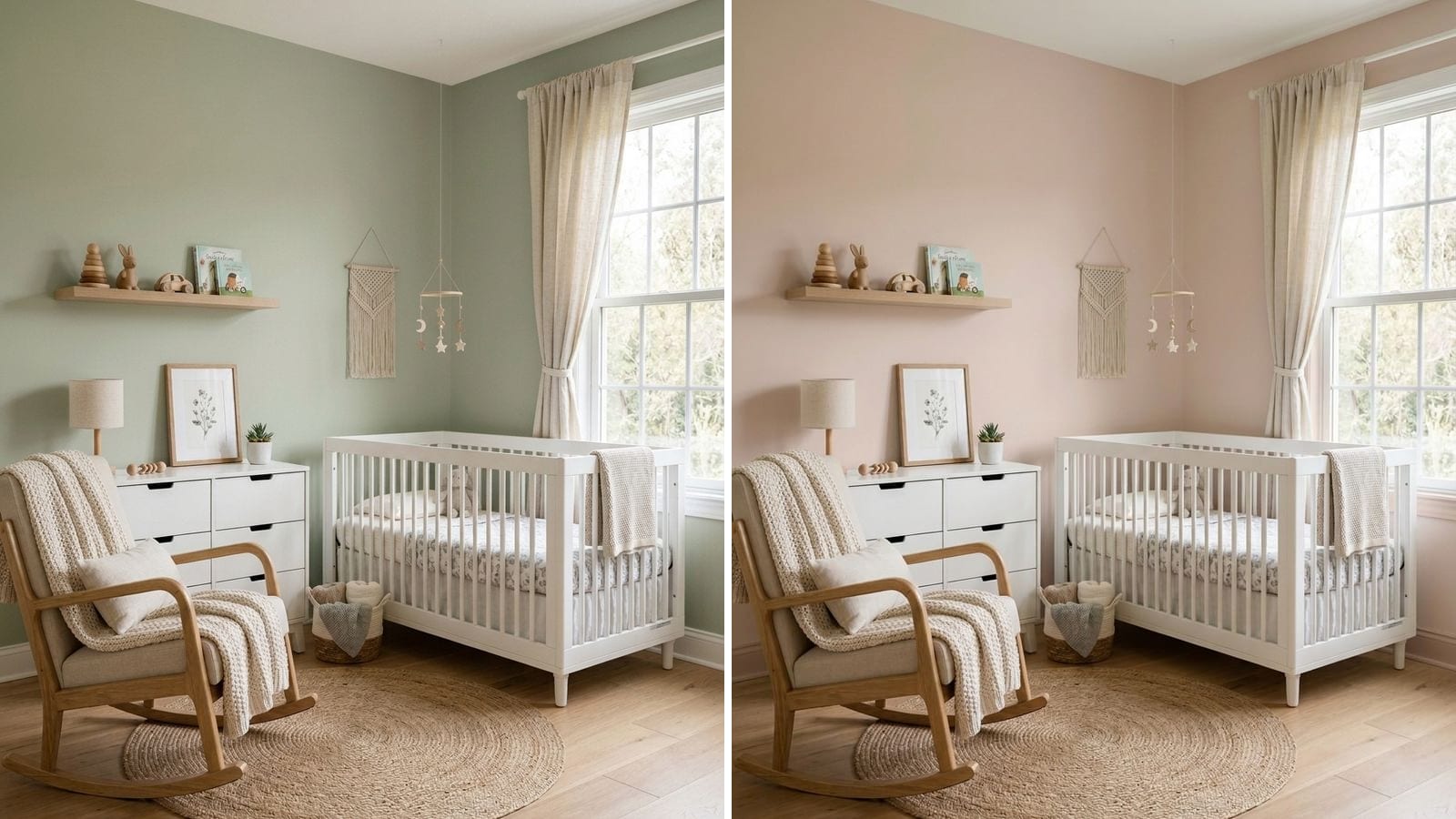
The easiest nursery and kids' room colors are soft and slightly muted: sage, pale blue-green, blush, warm white or light greige, such as Sea Salt (SW 6204), Palladian Blue (HC-144) or First Light (2102-70). They stay calm for years and work for a boy or a girl, and the toys and bedding can bring the color. Save a deeper color like Hale Navy (HC-154) for one wall or for an older child's room.
You will read a lot of confident claims that a certain color makes babies sleep better or kids calmer. We could not find solid research behind them, so this guide sticks to what you can check: the colors themselves, how they behave in light, and what the paint label actually promises. Codes, hex values and LRV come from the manufacturers' color data in Muro. A screen only approximates a color, so a sample on the wall has the final say.
Does wall color affect a baby's sleep?
There is no good evidence that a particular wall color helps a baby or child sleep. What sleep experts point to is the room itself: the Sleep Foundation recommends keeping a bedroom cool, quiet and dark, and notes that evening light and screens can delay sleep (Sleep Foundation, Bedroom Environment).
So pick a color you like living with, and put the sleep budget into blackout curtains and dim, warm lamps. A soft color does help in one practical way. It does not glare under a lamp at night the way a stark white can, and it does not take over the room the way a saturated one does.
1. Soft sage and gray-green
Gray-greens are an easy gender-neutral choice. They go with wood furniture and white cribs and work in north- and south-facing rooms alike, and they should still look right when the child is ten.
| Brand | Color | Code | Hex | LRV (calc.) |
|---|---|---|---|---|
| Sherwin-Williams | Sea Salt | SW 6204 | #CDD2CA | 63.3 |
| Sherwin-Williams | Rainwashed | SW 6211 | #C2CDC5 | 59.2 |
| Benjamin Moore | October Mist | 1495 | #B6B8A5 | 46.9 |
Sea Salt sits between green, gray and a touch of blue and can read greener or bluer depending on the light. October Mist is a deeper, more olive sage, better when the room gets plenty of daylight.
2. Pale blue and blue-green
Soft blues and blue-greens feel fresh without being cold, as long as they have a little gray or green in them. A clear, bright baby blue starts to look childish fast. A muted one holds up better as the child grows.
| Brand | Color | Code | Hex | LRV (calc.) |
|---|---|---|---|---|
| Benjamin Moore | Palladian Blue | HC-144 | #C1D1C9 | 61.2 |
| Benjamin Moore | Wythe Blue | HC-143 | #AABEB4 | 48.7 |
| Sherwin-Williams | Upward | SW 6239 | #BFC9D0 | 57.4 |
These blues look best in south- and east-facing rooms and next to white furniture. In a north-facing room, cool light pushes them grayer, so test them there especially. Our guide to north-facing room colors explains why.
3. Blush, pale pink and clay
In a nursery, a dusty, warm pink usually ages better than bubblegum. A blush with a little beige in it looks soft in daylight and gets cozy under warm lamps.
| Brand | Color | Code | Hex | LRV (calc.) |
|---|---|---|---|---|
| Benjamin Moore | First Light | 2102-70 | #EFE2DE | 78 |
| Sherwin-Williams | Intimate White | SW 6322 | #F0E1D8 | 77.3 |
| Sherwin-Williams | Romance | SW 6323 | #EBCFC3 | 66.2 |
| Sherwin-Williams | Redend Point | SW 9081 | #AE8E7E | 29.9 |
First Light and Intimate White are barely-there pinks that read almost white from across the room. Redend Point is a muted clay, better on one wall behind the crib or bed than on all four. Blushes also help a north-facing room that needs some warmth.
4. Warm white and light greige
If you want the room to be a quiet backdrop for colorful bedding, art and toys, go light and warm. A white with a little warmth in it will not glare.
| Brand | Color | Code | Hex | LRV (calc.) |
|---|---|---|---|---|
| Sherwin-Williams | Greek Villa | SW 7551 | #F0ECE2 | 84 |
| Benjamin Moore | Swiss Coffee | OC-45 | #EEECE1 | 83.6 |
| Benjamin Moore | Pale Oak | OC-20 | #DDD9CE | 69.5 |
| Sherwin-Williams | Agreeable Gray | SW 7029 | #D1CBC1 | 60.1 |
If you are choosing between whites, our guide to white paint undertones helps you see the difference before you buy. These neutrals suit small rooms and rooms whose theme will change every few years. More whites are in 12 best white paint colors.
5. One deeper color for an older child
Toddlers and older kids often want a "real" color. Give them one wall, the lower half below a chair rail, or the back of the built-in shelves, and keep the rest of the room light.
| Brand | Color | Code | Hex | LRV (calc.) |
|---|---|---|---|---|
| Benjamin Moore | Hale Navy | HC-154 | #434B56 | 6.9 |
| Sherwin-Williams | Evergreen Fog | SW 9130 | #95978A | 30.4 |
| Sherwin-Williams | Naval | SW 6244 | #2F3D4C | 4.5 |
The wall behind a bed and a reading nook are good places for these. In a room two kids share, each can get a zone.
LRV (light reflectance value) runs from 0 for black to 100 for pure white. The values in these tables are calculated from the hex values, not published by the manufacturers.
What does zero-VOC paint really mean for a nursery?
VOCs (volatile organic compounds) are chemicals that evaporate from products such as paint. The EPA lists paints among the household sources of VOCs, finds levels of several VOCs indoors averaging 2 to 5 times higher than outdoors, and advises increasing ventilation when you use products that emit them (EPA, VOCs' Impact on Indoor Air Quality).
A low- or zero-VOC paint is a sensible choice for a baby's room, but read the label with care. "Zero VOC" on a can is not the whole story: in 2017 the FTC settled charges against four paint companies, including Benjamin Moore, over claims that paints were emission-free, VOC-free and safe for babies and pregnant women; the FTC said the companies had no evidence for those claims (FTC, July 2017).
A third-party emissions certification tells you more. UL GREENGUARD Gold sets limits on emissions of more than 360 VOCs and is aimed at products used in nurseries, schools and healthcare spaces (UL). Check the specific product line, not just the brand.
Then ventilate. Open windows while you paint and afterwards, and finish the nursery well before the baby moves in, so the room has time to air out.
Is the old paint in the room safe?
If your home was built before 1978, it is more likely to have lead-based paint, and sanding or scraping it can create lead dust that is dangerous for children. The EPA advises having the home inspected or assuming lead is present, and hiring a lead-safe certified contractor or following its lead-safe practices if you do the work yourself (EPA). In an older house, settle this before you choose a color.
Which finish for a kids' room?
Pick a finish you can wipe. Our paint finish guide recommends satin for kids' rooms, with semi-gloss on trim and doors that collect fingerprints.
What to avoid in a nursery
Skip bright, saturated colors on all four walls. A primary red or bright yellow overwhelms a small room, and the toys will bring plenty of color anyway. The same goes for theme colors you will repaint in two years: put the theme in bedding, decals and art, and keep the walls more neutral.
Don't choose from a tiny chip under store lighting either, since pastels can turn gray, green or peachy depending on your window and bulbs. And don't leave the painting to the week before the due date, because the room needs time to air out.
How to check a color before you buy
- Paint a large sample on the wall where the crib or bed will go and on the wall facing the window.
- Check it at night with the lamp you'll use for feedings, because that is when you'll see the room most.
- Hold the bedding, crib and rug next to it. A wall color is never seen alone.
To avoid ending up with a stack of sample pots, you can narrow the list in Muro first. You take a photo of the nursery, pick a real paint by name or code, for example Sea Salt (SW 6204) or First Light (2102-70) from the tables above, and see it on your own walls. In the iPhone app you can view the room by day, at sunset and at night, with lamps on or off. You can also start in your browser at app.usemuro.com. Once the color is settled, the paint calculator tells you how much to buy, and our guide to what it costs to paint a room helps with the budget.
FAQ
What is the best gender-neutral nursery color?
Soft gray-greens and warm neutrals are the safest. Sea Salt (SW 6204), October Mist (1495) and Pale Oak (OC-20) all work with wood or white furniture and with either pink or blue accents.
What color is calming for a nursery?
Muted, light colors feel calmest: sage, pale blue-green such as Palladian Blue (HC-144), or blush such as First Light (2102-70). There is no solid evidence that a specific wall color improves a baby's sleep; a cool, quiet, dark room matters more.
Is zero-VOC paint safe for a nursery?
Low- or zero-VOC paint lowers what the paint releases, which is a good idea in a baby's room. Back the label up with a third-party emissions certification such as UL GREENGUARD Gold, ventilate well and paint well before the baby arrives.
How long before the baby arrives should I paint the nursery?
As early as you can, so the room has time to air out with the windows open. Follow the drying and ventilation directions on the can.
Should I paint a nursery a dark color?
Use a deep color like Hale Navy (HC-154) on one wall rather than all four, especially in a small room. Light colors keep the room bright for daytime play. More navies are in best navy blue paint colors.