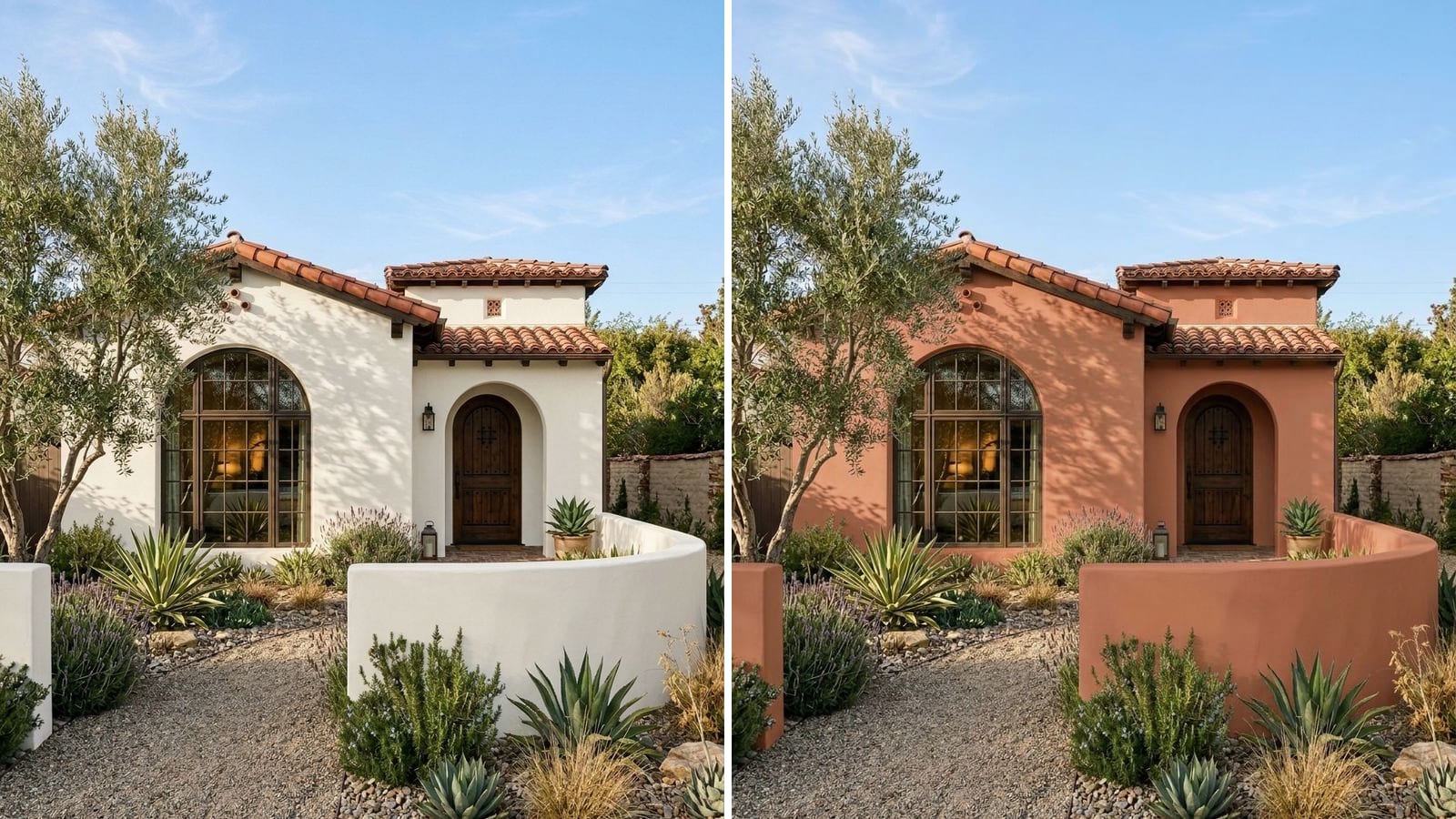
The stucco colors that hold up best are warm whites (Alabaster, SW 7008), sandy beiges and khakis (Kilim Beige, SW 6106; Manchester Tan, HC-81), soft greige (Revere Pewter, HC-172) and earthy clays like Redend Point (SW 9081) or Cavern Clay (SW 7701). Muted sage works too. Pick a shade a little lighter than the chip you like, because stucco texture throws small shadows and makes every color read darker.
Below are five palettes with real paints you can buy, plus the two technical things that matter more on stucco than on siding: how dark you can go, and how long new stucco has to sit before you paint it. Codes, hex values and LRV come from the manufacturers' color data in Muro. The LRV in the tables is calculated from the hex, so for anything close to a limit, check the number the manufacturer publishes. A screen only approximates a color, and outdoor light shifts it again, so a large sample on your own wall decides.
Why colors look different on stucco
A smooth siding board reflects light evenly. Stucco doesn't. Sand finish, lace, dash or Santa Barbara texture all break the surface into tiny ridges, and every ridge casts a shadow. From the street those shadows mix into the color, so the wall reads a bit darker and grayer than the chip.
Sun works the other way. A big, flat stucco wall in full Arizona or Texas sun can look washed out at noon, then turn warm and deep at sunset. That is why one color can look chalky on the south side and muddy on the north side of the same house.
Two practical rules follow from that:
- Go about one step lighter than the chip on heavy textures, and stay on the chip on smooth finishes.
- Judge samples on the actual texture. A painted card held against the wall shows a smooth color; a patch rolled onto the stucco shows the real one.
How dark can you go on stucco?
It depends on what is behind the finish. Some of what people call stucco is actually EIFS: a thin finish coat over foam insulation board. Sto Corp, one of the main EIFS makers, says polystyrene board can deform above 165°F, and that colors with an LRV of 20 or more are safe anywhere in North America on a vertical wall (Technical Hotline TH 1294-E, revised August 2025). Below that, the board can overheat in strong sun.
Traditional three-coat cement stucco over lath doesn't have foam in it, so this limit is written for EIFS. If you don't know which one you have, check the house's building records or ask a stucco contractor. Until you know, keep the field color at LRV 20 or above and save the deep shades for doors, shutters and trim. More on what LRV means is in how LRV affects your paint choice.
New stucco: wait before you paint
Fresh stucco is strongly alkaline, and paint applied too early can fail. Sherwin-Williams says new masonry surfaces usually need about 30 days to cure, the time it takes for the pH to drop from 13–14 to about 9. If you can't wait, their guidance is at least 7 days of curing and a pH under 13, then a masonry primer (they name Loxon Acrylic Masonry Primer). A pH test strip from a pool or garden store tells you where you are.
What to avoid on a stucco house
- Stark, bluish white on a big wall. In strong sun it glares, and next to a tile roof it looks cold. Warm whites look better from the street.
- A color picked from a 2-inch chip. On a whole house, mid-tone beiges and clays look stronger than you expect. Look at it big.
- Very dark field colors on EIFS. Under LRV 20 you are outside what Sto calls safe for foam-backed systems.
- Flat gray with no warmth next to terracotta tile. The roof turns orange and the walls look like concrete.
1. Warm whites
The classic Spanish Revival and Mission look: warm white walls, terracotta roof, dark iron and wood. A white with some cream in it softens the glare and keeps the texture visible. If you're torn between two whites, white paint undertones explained shows why one leans yellow and another blue.
| Brand | Color | Code | Hex | LRV (calc.) |
|---|---|---|---|---|
| Sherwin-Williams | Alabaster | SW 7008 | #EDEAE0 | 82.2 |
| Sherwin-Williams | Greek Villa | SW 7551 | #F0ECE2 | 84.0 |
| Benjamin Moore | Swiss Coffee | OC-45 | #EEECE1 | 83.6 |
| Behr | Ivory Lace | PPU7-15 | #ECE1CE | 76.1 |
Ivory Lace is the warmest of the four. It looks good with a red tile roof, less so with a cool gray one.
2. Sand, beige and khaki
This is the Southwest palette. Sand and khaki show less dust than white and sit well next to gravel, cactus and desert plants. Lighter sands like Manchester Tan work on big two-story walls. Universal Khaki, the Sherwin-Williams Color of the Year 2026, is deeper and better on a single-story ranch or as a base for white trim.
| Brand | Color | Code | Hex | LRV (calc.) |
|---|---|---|---|---|
| Benjamin Moore | Manchester Tan | HC-81 | #DBD2BC | 64.8 |
| Sherwin-Williams | Kilim Beige | SW 6106 | #D7C5AE | 57.4 |
| Behr | Bungalow Beige | HDC-AC-10 | #CCBFAC | 53.1 |
| Sherwin-Williams | Universal Khaki | SW 6150 | #B8A992 | 40.6 |
3. Greige and warm gray
Greige fits newer stucco homes with a gray or charcoal roof, black windows and simpler lines. It still has some warmth, so it doesn't turn into concrete in shade. Revere Pewter and Agreeable Gray are both in the same light-to-mid range; Pavement Gray is the darker option for a modern look and still sits above LRV 20.
| Brand | Color | Code | Hex | LRV (calc.) |
|---|---|---|---|---|
| Sherwin-Williams | Agreeable Gray | SW 7029 | #D1CBC1 | 60.1 |
| Benjamin Moore | Revere Pewter | HC-172 | #CBC6B8 | 56.5 |
| Behr | Pavement Gray | MQ6-25 | #8C887D | 24.7 |
4. Terracotta and clay
Clay colors look natural on Mediterranean and Santa Fe style houses and pick up the warmth of evening light. Redend Point is a dusty, muted clay that works on a whole house. Cavern Clay and Terra Cotta Urn are stronger, and on a full facade they read loud, so many people use them on one volume, a garden wall or a courtyard.
| Brand | Color | Code | Hex | LRV (calc.) |
|---|---|---|---|---|
| Sherwin-Williams | Redend Point | SW 9081 | #AE8E7E | 29.9 |
| Behr | Terra Cotta Urn | PPU2-12 | #B06F61 | 21.5 |
| Sherwin-Williams | Cavern Clay | SW 7701 | #AC6B53 | 19.9 |
Cavern Clay sits right on the LRV 20 line by our calculation. On EIFS, check the manufacturer's published LRV before you commit.
5. Sage and gray-green
Muted greens blend stucco into the garden, especially with olive trees, agave or lots of shade. Keep the green gray, or it will look like a garden shed from the street. Saybrook Sage is soft enough for a whole house; Evergreen Fog is deeper and pairs well with warm white trim.
| Brand | Color | Code | Hex | LRV (calc.) |
|---|---|---|---|---|
| Benjamin Moore | Saybrook Sage | HC-114 | #B1B7A2 | 45.8 |
| Behr | Sage Wisdom | MQ6-27 | #ACA995 | 39.3 |
| Sherwin-Williams | Evergreen Fog | SW 9130 | #95978A | 30.4 |
Trim, doors and accents on stucco
Stucco houses usually have less trim than sided ones, so the accents do more work: window frames, fascia, gates, a front door, exposed beams. Dark bronze and black are the safe pair. They sit on small surfaces, so the LRV limit for big walls doesn't apply to them in the same way.
| Brand | Color | Code | Hex | LRV (calc.) |
|---|---|---|---|---|
| Sherwin-Williams | Urbane Bronze | SW 7048 | #54504A | 8.1 |
| Sherwin-Williams | Tricorn Black | SW 6258 | #2F2F30 | 2.9 |
Some combinations that work together:
| House style | Walls | Trim and accents |
|---|---|---|
| Spanish Revival, red tile roof | Alabaster SW 7008 | Urbane Bronze SW 7048 |
| Santa Fe or Pueblo | Kilim Beige SW 6106 | Redend Point SW 9081 on doors |
| Mediterranean | Redend Point SW 9081 | Swiss Coffee OC-45 |
| Modern, charcoal roof | Agreeable Gray SW 7029 | Tricorn Black SW 6258 |
| Ranch with lots of greenery | Saybrook Sage HC-114 | Greek Villa SW 7551 |
For the front door alone there are more options in front door colors that work with your house, and the roof matters as much as the walls: see what roof color goes with your house.
How to check a color before you buy
- Roll samples straight onto the stucco, at least 2 by 2 feet, on the sunny side and the shady side.
- Look at them in the morning, at noon and in the late afternoon. Clays and sands change the most as the sun drops.
- Walk to the street. People see your house from the curb, and texture shadows only show from a distance.
You can cut the list down before buying any sample pots. In Muro you take a photo of your house from the street, pick a real paint by name or code, for example from the tables above, and see your own stucco walls in that color. In the iPhone app you can switch between day, sunset and night. You can also start in a browser at app.usemuro.com. For more exterior ideas beyond stucco, see the best exterior house colors, and once you've picked, the paint calculator helps with quantities.
FAQ
What is the most popular color for a stucco house?
Warm white and light sand are the most common choices. Alabaster (SW 7008) and Swiss Coffee (OC-45) are safe whites; Manchester Tan (HC-81) and Kilim Beige (SW 6106) are classic sandy stucco colors.
What color stucco goes with a red tile roof?
Warm white, cream or sand. Ivory Lace by Behr (PPU7-15) or Alabaster (SW 7008) let the tile stand out. Avoid cool grays, which make the roof look orange.
Can you paint stucco a dark color?
On EIFS with foam insulation, Sto Corp recommends colors with LRV 20 or higher. Pavement Gray by Behr(MQ6-25, LRV about 25 by our calculation) is a darker option that stays above that line. Put the really dark shades on doors and trim.
How long should new stucco cure before painting?
Sherwin-Williams says usually about 30 days. With a masonry primer you can paint after 7 days if the pH has dropped below 13.
Does stucco make paint look darker?
Usually, yes. Textured finishes cast small shadows that mix into the color, so a chip that looks right in your hand can look a step darker on the wall. Choose one step lighter on heavy textures.
What colors are trending for stucco houses?
Warm neutrals and earthy colors: khaki like Universal Khaki (SW 6150), dusty clay like Redend Point (SW 9081) and muted sage like Saybrook Sage (HC-114). Sherwin-Williams picked a warm khaki as its 2026 Color of the Year, which points the same way.