Yes, within limits. Many current exterior latex paints from Sherwin-Williams, Benjamin Moore and Behr can go on at 35°F, as long as the air, the surface and the paint stay at or above that point while the paint dries. Interior paints from the same brands want 50°F or more. The forecast low for the night after you paint matters as much as the temperature while you paint.
All temperatures below come from the manufacturers' own product pages and technical data sheets, linked in each row. Your can's label and the data sheet for the exact product always win over any article, including this one.
Minimum temperatures by brand and product
| Brand | Product | Use | Minimum | Source |
|---|---|---|---|---|
| Sherwin-Williams | Duration, Resilience, SuperPaint, A-100 Exterior | Exterior | 35°F | SW exterior application FAQ |
| Sherwin-Williams | Emerald Interior Acrylic Latex (K37) | Interior | Above 50°F | SW product data sheet |
| Benjamin Moore | Regal Select Exterior (N400) | Exterior | 35°F (range 35–100°F) | BM product page |
| Benjamin Moore | Regal Select Interior Eggshell (N549) | Interior | 50°F (range 50–90°F) | BM product page |
| Behr | Premium Plus Exterior Flat | Exterior | 35°F air and surface, for 4 hours after | Behr data sheet |
| Behr | Premium Plus Interior Flat | Interior | 50°F air and surface | Behr data sheet |
Checked November 16, 2026. The Behr sheets are hosted by Home Depot, which sells Behr.
Two things stand out. First, the 35°F figure is a product feature, not a rule for all paint. Sherwin-Williams' own FAQ says that until a few years ago you needed to paint above 50°F, and that traditional latex paints need temperatures above 60°F to cure properly. Second, interior paint isn't built for the cold at all: 50°F is the floor for every interior product in the table.
It's not the air: three temperatures that count
Sherwin-Williams says the label temperatures refer to air, surface and material temperatures. All three:
- Air is what the forecast shows.
- Surface is the wall itself. A north wall in shade, or siding in the early morning, can be colder than the air. An infrared thermometer costs little and tells you the truth.
- Material is the paint in the can. A can left overnight in a cold garage or truck starts the day too cold. Store it indoors.
Behr's exterior data sheet adds a time window: air and surface have to stay between 35 and 90°F for at least 4 hours after you apply the paint.
The night after matters most
Sherwin-Williams calls this out as a common mistake: painting when daytime temperatures rise above 50°F and nighttime temperatures drop below 35°F. The paint goes on fine at noon, then freezes or gets wet before it forms a film.
Their recommendation for exterior work: ideally, the temperature should stay in the label range and above the dew point for at least 48 hours after you paint. Cold surfaces and moisture keep a paint film from forming properly.
In practice, for a cold-season exterior job:
- Check the 48-hour forecast, not just today. Look at the overnight low and the dew point.
- Start late morning, after dew and frost have dried off the surface.
- Stop early in the afternoon. Sherwin-Williams notes that most products need at least 4 hours of dry time before moisture settles, and dew forms after sunset.
- Follow the sun. Paint the walls that get sun while they're warm, and leave shaded walls for a warmer day.
- Skip rainy or foggy days. Behr's sheet says not to paint when rain or heavy condensation is expected.
Painting inside in winter
Indoors the trouble is cold, damp walls and slow drying. Frost doesn't come into it.
- Keep the room at 50°F or more day and night while the paint dries. That's the minimum for the interior paints in the table above.
- Watch exterior walls. In an unheated room or a closed-off addition, an outside wall can be colder than the air. Check it.
- Expect longer drying. Behr's data sheets note that cooler temperatures or higher humidity may prolong drying time. Leave more time before the second coat. Our guide on how long paint takes to dry has the details.
- Ventilate without freezing the room. Crack a window briefly and keep the heat on, rather than leaving windows open overnight.
What to avoid in cold weather
- Assuming every exterior paint is a 35°F paint. Check the product's data sheet. Other formulas may need 50°F.
- Painting over frost, dew or a damp surface. Even if the air is warm enough, a wet surface ruins adhesion.
- Using paint stored in the cold. Bring cans inside the night before.
- Painting late in the day. The coat needs hours of dry time before the dew comes.
- Ignoring the next two nights. A warm afternoon doesn't help if the temperature drops below the minimum before the paint has formed a film.
Too cold right now? Choose the color instead
If the forecast rules out painting until spring, use the winter to settle the color. Here is a short list from Sherwin-Williams and Benjamin Moore to start from, from white siding to dark trim and doors. More colors for the outside of the house are in best exterior house paint colors.
| Brand | Color | Code | Hex | LRV (calc.) |
|---|---|---|---|---|
| Sherwin-Williams | Pure White | SW 7005 | #EDECE6 | 83.7 |
| Sherwin-Williams | Alabaster | SW 7008 | #EDEAE0 | 82.2 |
| Sherwin-Williams | Repose Gray | SW 7015 | #CCC9C0 | 58.4 |
| Sherwin-Williams | Urbane Bronze | SW 7048 | #54504A | 8.1 |
| Sherwin-Williams | Iron Ore | SW 7069 | #434341 | 5.6 |
| Sherwin-Williams | Naval | SW 6244 | #2F3D4C | 4.5 |
| Benjamin Moore | Hale Navy | HC-154 | #434B56 | 6.9 |
Whites and light grays work as siding on most houses. Urbane Bronze and Iron Ore are for trim, shutters and doors. Naval and Hale Navy look good on a front door, or on the whole house if the trim is white. For more on what buyers respond to, see exterior colors that increase home value. Door options are in front door colors that work with your house.
How to check a color before you buy
- Paint samples on a board, not the siding, while it's cold. A board can go up against the house on a mild day and come down again.
- Look at the samples on the north and south sides of the house. Exterior colors change a lot with the direction of the light.
- Look from the street, not from a foot away. That's how you and your neighbors will see the house.
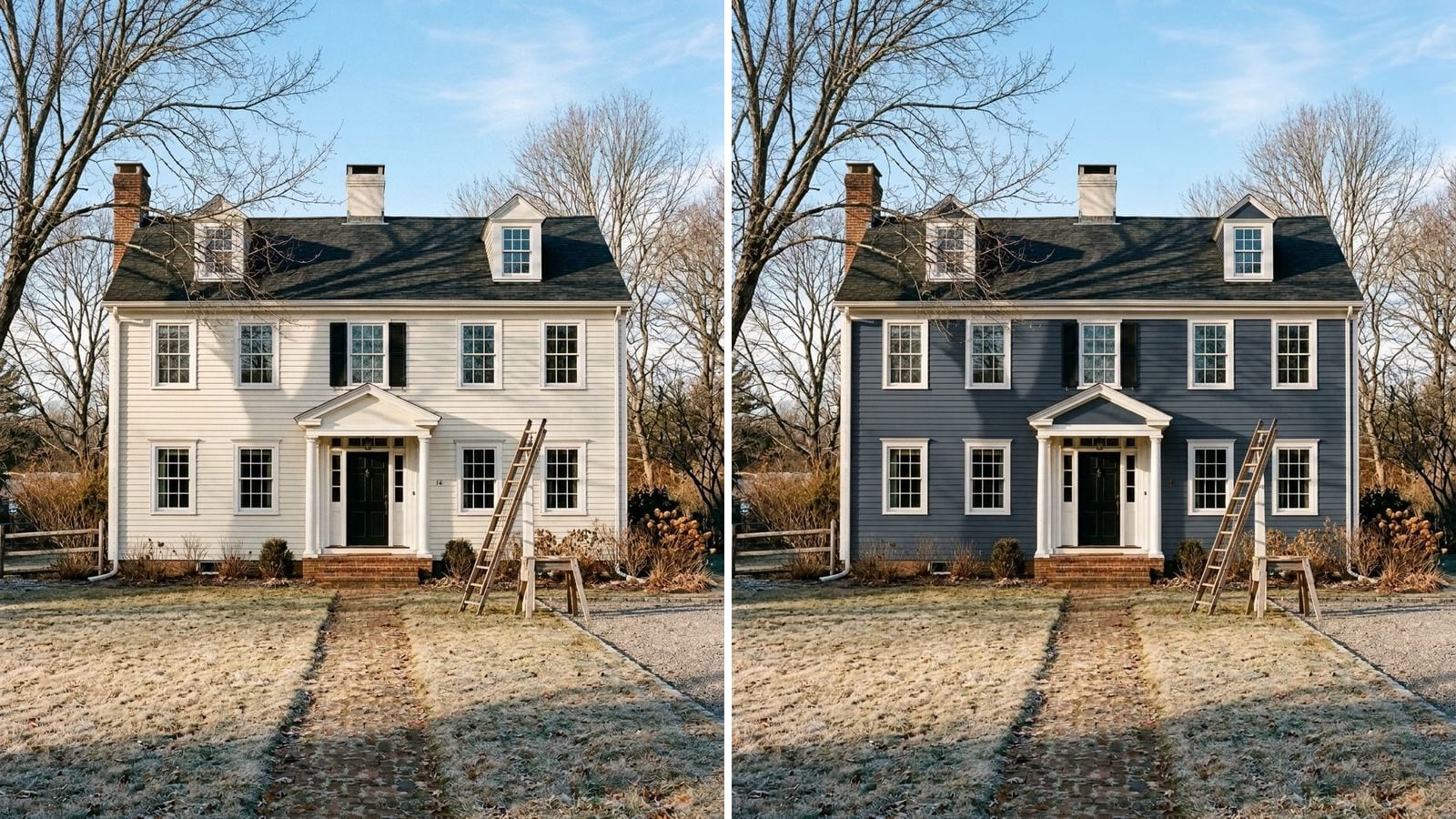
To see the color on the whole house first, you can use Muro. You take a photo of your house from the street, pick a real paint by name or code, for example Alabaster SW 7008 for the siding or Naval SW 6244 for the door, and see it on your own facade. In the iPhone app you can also check it at sunset and at night. You can start in your browser at app.usemuro.com. When spring comes, you buy samples of the winner and a can of the right paint for the season.
Once the color is settled, the paint calculator tells you how much to buy.
FAQ
What is the lowest temperature you can paint outside?
For many current exterior latex paints it's 35°F, for example Sherwin-Williams Duration and SuperPaint, Benjamin Moore Regal Select Exterior and Behr Premium Plus Exterior. Older or other formulas may need 50°F, so check the product's data sheet.
Can you paint inside when it's cold outside?
Yes, if the room stays at 50°F or warmer day and night while the paint dries. Interior paints such as Benjamin Moore Regal Select Interior list 50–90°F as their application range.
Is 40 degrees too cold to paint outside?
Not for paints rated to 35°F, as long as the surface is dry, the paint is warm enough and the temperature stays above 35°F and above the dew point for the next 48 hours. For paints that require 50°F, yes, it's too cold.
What happens if paint freezes before it dries?
The paint film may not form properly. Sherwin-Williams says colder temperatures and moisture on the surface will not allow a paint film to form properly. That's why the overnight low after you paint matters as much as the daytime temperature.
How long does paint need to dry before it gets cold?
Behr's exterior data sheet asks for at least 4 hours within the 35–90°F range after applying, and Sherwin-Williams recommends staying above the dew point for 48 hours. Stop painting early enough in the day that the coat dries before evening dew.
Does temperature matter for the paint color?
No. Cold changes how the paint film forms and dries, and the color in the can stays what it is. Pick colors like Repose Gray SW 7015 or Iron Ore SW 7069 for their look, and pick the product for the weather.