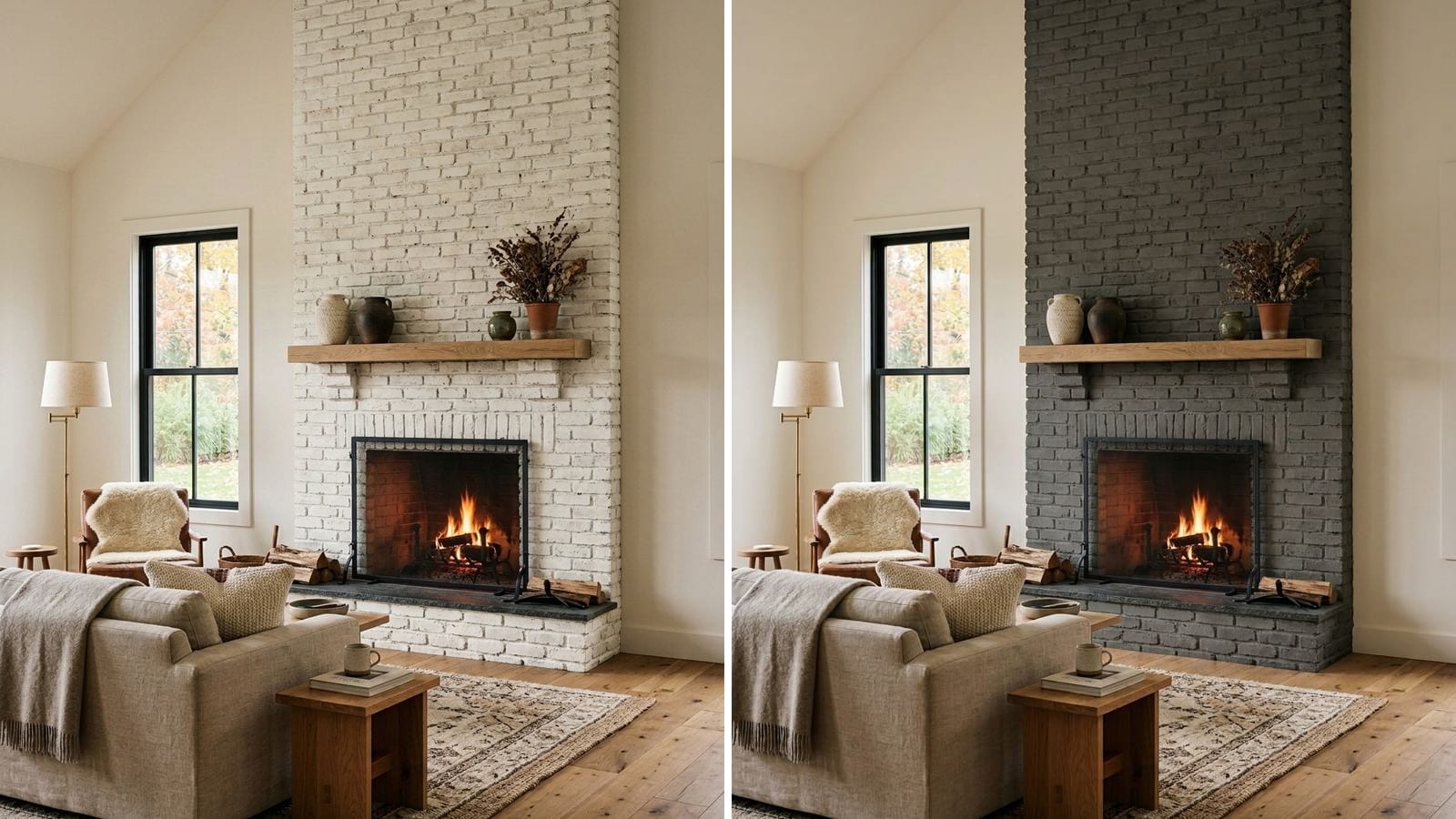
The safest colors for a painted brick fireplace are warm whites like Sherwin-Williams Alabaster (SW 7008) or Benjamin Moore Swiss Coffee (OC-45), and soft greige like Agreeable Gray (SW 7029). For a fireplace that stands out, go dark: charcoal like Iron Ore (SW 7069), a near-black like Tricorn Black (SW 6258), or navy like Hale Navy (HC-154). Paint only the outside face of the brick, never the inside of the firebox.
Codes, hex values and LRV below come from the manufacturers' color data in Muro. A hex value on a screen is an approximation, and brick makes it trickier: the texture throws small shadows, so the same paint reads a little darker on brick than on a flat wall. Put a sample on the brick itself before you buy gallons.
First decide: should the fireplace blend in or stand out?
- Blend in. Paint the brick the same color as the wall, or one step lighter or darker. The brick texture does the work. Benjamin Moore suggests going further for a modern look and painting the mantel the same color as the brick and the wall.
- Stand out. Pick a color clearly darker than the walls. A charcoal or navy fireplace against light walls becomes the focal point, which makes sense when the fireplace is the reason the room exists.
Light also matters. In a north-facing room with cool light, pure bright whites on brick can turn gray and flat, and warmer whites hold up better. In a sunny room you can use almost anything, darks included.
1. Warm whites: the classic painted brick look
White is the most common choice, and Benjamin Moore says as much in its fireplace guide. On brick, a warm white with a little cream in it usually looks better than a stark white. Mortar joints and the uneven face throw shadows, and a cool white with shadows reads as gray.
| Brand | Color | Code | Hex | LRV |
|---|---|---|---|---|
| Sherwin-Williams | Alabaster | SW 7008 | #EDEAE0 | 82.2 |
| Sherwin-Williams | Greek Villa | SW 7551 | #F0ECE2 | 84 |
| Benjamin Moore | Swiss Coffee | OC-45 | #EEECE1 | 83.6 |
| Behr | Ivory Lace | PPU7-15 | #ECE1CE | 76.1 |
Alabaster and Swiss Coffee are close and both safe. Greek Villa is a touch brighter, Ivory Lace the creamiest, good with warm wood floors. If the walls are already white, use the same white on the brick so the two don't fight. Our guide to white paint colors goes through undertones in more detail.
2. Greige and soft gray: when white feels too bright
If the room already has white walls and you want the fireplace to show up without going dark, greige is the middle ground. It also hides soot and smudges better than white, which matters on a fireplace you actually use.
| Brand | Color | Code | Hex | LRV |
|---|---|---|---|---|
| Sherwin-Williams | Agreeable Gray | SW 7029 | #D1CBC1 | 60.1 |
| Benjamin Moore | Revere Pewter | HC-172 | #CBC6B8 | 56.5 |
| Benjamin Moore | Pale Oak | OC-20 | #DDD9CE | 69.5 |
| Behr | Graceful Gray | PPU18-12 | #BEB6AE | 47.5 |
Pale Oak is the lightest, almost an off-white. Agreeable Gray and Revere Pewter work with white and beige walls alike. Graceful Gray is darker and a little warmer, for a visible but quiet contrast.
3. Charcoal and black: the fireplace as the focal point
A dark fireplace is the strongest look and more forgiving than you'd think: soot barely shows, and it ties in with a black metal screen or doors.
| Brand | Color | Code | Hex | LRV |
|---|---|---|---|---|
| Sherwin-Williams | Iron Ore | SW 7069 | #434341 | 5.6 |
| Sherwin-Williams | Tricorn Black | SW 6258 | #2F2F30 | 2.9 |
| Benjamin Moore | Soot | 2129-20 | #373C41 | 4.4 |
| Benjamin Moore | Kendall Charcoal | HC-166 | #676662 | 13.3 |
| Behr | Cracked Pepper | PPU18-01 | #4F5152 | 8.2 |
Iron Ore is a soft charcoal that won't look like a black hole in a small room. Tricorn Black is close to true black. Soot, which Benjamin Moore names as a fireplace option, leans slightly blue. Kendall Charcoal is the lightest, a safer start if full black scares you. There's more on picking a dark shade in our black paint colors guide.
4. Navy and earthy colors: color without going black
Navy works when you want something dark but softer than black, and it looks good next to wood floors and brass. Benjamin Moore lists Hale Navy among its suggestions for a painted fireplace. A brown-gray or clay suits warmer rooms with lots of wood.
| Brand | Color | Code | Hex | LRV |
|---|---|---|---|---|
| Benjamin Moore | Hale Navy | HC-154 | #434B56 | 6.9 |
| Sherwin-Williams | Naval | SW 6244 | #2F3D4C | 4.5 |
| Sherwin-Williams | Urbane Bronze | SW 7048 | #54504A | 8.1 |
| Sherwin-Williams | Cavern Clay | SW 7701 | #AC6B53 | 19.9 |
Hale Navy is grayer, Naval deeper and bluer. Urbane Bronze is a warm brown-gray that stays quiet next to wood. Cavern Clay is the brave one, a terracotta that brings back some of the brick's warmth in one even color.
What the paint makers say about heat and prep
- Leave the firebox alone. Benjamin Moore: "Paint only the outside of your brick fireplace, not the interior of the fire box." Areas exposed to open flame need a specialized high-heat product.
- High-heat paint is for metal, not the inside of the fireplace. Rust-Oleum High Heat spray keeps its color up to 1200°F on metal such as wood stoves and grills, and its label says not to use it in areas directly exposed to flames, including the inside of fireplaces. Krylon High Heat Max is rated to 1200°F intermittently and 600°F continuously, for things like fireplace screens. So high-heat paint is for a tired screen or metal surround, not the brick inside.
- Clean first, then let it dry. Sherwin-Williams has you wire-brush and vacuum, then scrub with a degreaser and rinse, testing the cleaner on a hidden spot first. Benjamin Moore says to let the brick dry for 24 hours before priming; Sherwin-Williams gives 24 to 48 hours.
- Prime, maybe twice. Sherwin-Williams uses Loxon Concrete & Masonry Primer/Sealer, which is made to resist alkali and efflorescence on masonry. Benjamin Moore uses Fresh Start High-Hiding All-Purpose Primer and notes that a second coat may be needed so soot or mineral stains don't bleed through, which matters most under whites. Let the primer dry overnight. More on when a separate primer is worth it in primer vs. paint and primer in one.
- Don't rush new brick. Sherwin-Williams says to wait at least a year after new brick goes in, because it is usually still moist.
- Brush the mortar, roll the face. Both brands work paint into the joints with a brush, then roll the brick face. Benjamin Moore suggests a 3/8 in. or 1/2 in. nap depending on how rough the brick is, and two coats of paint.
On sheen, the brands lean different ways. Benjamin Moore says matte or eggshell keeps the natural texture of the brick, while semi-gloss is easier to clean. Sherwin-Williams recommends satin, semi-gloss or gloss on a fireplace because soot wipes off more easily. A fair rule: matte or eggshell for a decorative fireplace you rarely light, satin or higher on one you use every winter. The paint finish guide explains the trade-offs.
What to avoid with a painted brick fireplace
- Painting before you're sure. Paint soaks into brick and mortar, and there is no quick way back to bare brick. Test the color first, and be sure you want painted brick at all.
- A stark, cool white in a dim room. On textured brick it tends to look gray and dull. Go for a warmer white.
- Skipping the second primer coat under white. If the brick has soot or old stains, they can show through light paint.
- Forgetting the hearth and mantel. Decide their color at the same time. A black mantel or one painted to match the brick are the two easy options.
How to check a color before you buy
- Test a small patch on a less visible side of the fireplace, since brick texture darkens the color more than a flat sample board shows.
- Look at it in the evening with the lamps on, and with a fire going if you use the fireplace. Warm light pushes whites toward cream and navy toward black.
- Test two options side by side, for example Alabaster and Agreeable Gray, or Iron Ore and Hale Navy.
You can narrow it down before buying samples too. In Muro you take a photo of your own living room, pick a real paint by name or code, for example from the tables above, and see it on your fireplace and walls. The iPhone app shows the room by day, at sunset and at night, with lamps on or off, and you can start in the browser at app.usemuro.com. To work out how much paint the job takes, use the paint calculator. If the rest of the house is brick too, we also wrote about trim, door and shutter colors for a brick house.
FAQ
What is the most popular color for a painted brick fireplace?
White and gray, according to Benjamin Moore. A warm white like Sherwin-Williams Alabaster (SW 7008) or Benjamin Moore Swiss Coffee (OC-45) is the usual pick, because cool whites tend to look gray on textured brick.
Is a black painted fireplace a good idea?
Yes, if the room has enough light and the walls are lighter. Iron Ore (SW 7069) is a soft charcoal that's easier to live with than a true black like Tricorn Black (SW 6258), and dark colors hide soot.
Do I need heat-resistant paint for a brick fireplace?
Not for the outside face of the brick: Benjamin Moore and Sherwin-Williams use their regular interior paints there over a primer. The inside of the firebox shouldn't be painted at all. High-heat paints like Rust-Oleum High Heat (up to 1200°F) are made for metal parts such as screens.
What sheen should I use on a brick fireplace?
Matte or eggshell keeps the brick texture, per Benjamin Moore. Satin or semi-gloss wipes clean more easily, which is why Sherwin-Williams recommends it for fireplaces you use.
Should the fireplace be the same color as the walls?
It can be. Painting brick, mantel and wall one color, for example Agreeable Gray (SW 7029), makes the fireplace blend in and the room look calmer. For a focal point, go clearly darker, such as Hale Navy (HC-154).