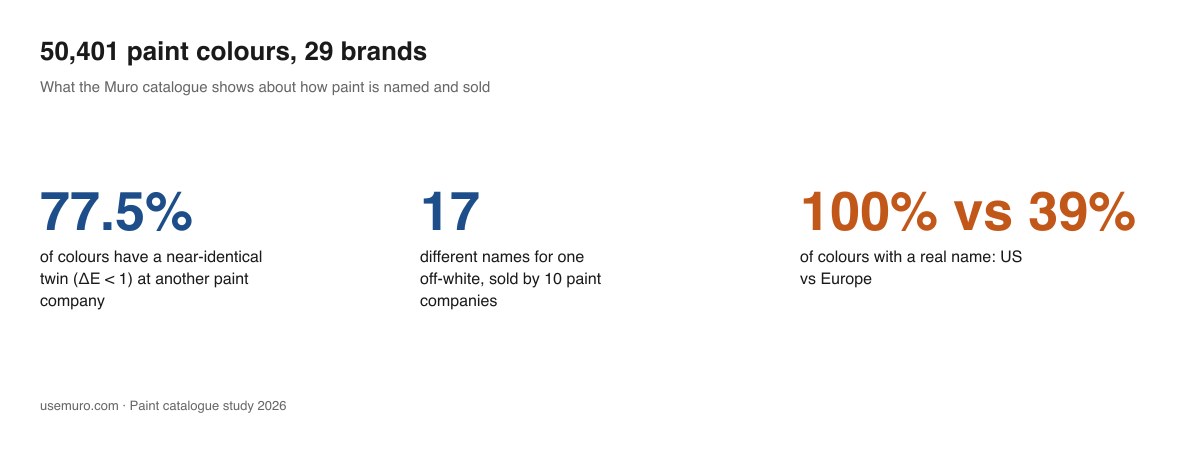
We compared 50,401 paint colors from 30 brands and found that most of them are not as unique as their names suggest: 77.5% have a near-identical twin (CIEDE2000 difference below 1) at another paint company, and a single off-white is sold by 10 paint companies under 17 different names. Every figure below is computed from the color catalog behind Muro, the app that shows real manufacturer paint colors on a photo of your own room.
You may quote any figure or table from this page, with a link to this page as the source.
Key findings
- One off-white, 17 names. 10 paint companies sell a color within a hair of
#F1EFE5(all within ΔE 0.5 of it, the largest gap between any two is 0.68). - 77.5% of colors have a twin. That is the share with a practically identical color (ΔE below 1) at a different paint company. 34% have one below ΔE 0.5, and 9.4% have the exact same hex value.
- Same name, different color. "Free Spirit" is the name of 6 different paint colors at 6 companies, and the two furthest apart differ by ΔE 32.2 (LRV from 19.5 to 82.8).
- The US names everything, Europe often does not. Practically all of the 18,230 US colors have a real name; in Europe it is 38.7% of 32,148, and 12 of 26 European catalogs ship at least three quarters of their colors as bare codes.
- European catalogs are 1.66 times greyer. Grey is 13.6% of the average European catalog and 8.2% of the average US one. The greyest catalog is Flügger at 23.7%.
- Paint names are about food, not grey. 5.9% of US color names contain a food word; 2.1% contain "gray" or "grey" (2.8 times fewer).
- Both sides paint the same lightness. The median LRV is 45.5 in US catalogs and 44 in European ones.
1. One off-white, many names
Take the off-white around #F1EFE5 and collect every color within ΔE 0.5 of it, skipping pairs from the same company. 10 paint companies sell it, in 32 catalog entries. 17 of them carry a real name; the rest are code-only entries. A selection:
| Brand | Name | Hex |
|---|---|---|
| Behr | Snowy Pine | #F0EEE5 |
| Behr | Nude W-f-210 | #F2F0E6 |
| Bruguer | Piedra Luna | #F2EFE5 |
| Dulux (PL) | LIGHT CREAM | #F2EFE5 |
| Dulux (PL) | perłowy biały | #F2EFE5 |
| Dulux (PL) | Kremowa Biel - MEBLE | #EFEDE3 |
| Jotun | Villahvit | #F1EFE5 |
| Tollens | Ivoire | #F0EEE4 |
| Tollens | Diaphane | #F0EEE4 |
| Valspar | Pale Bloom | #F2EFE5 |
| Zolpan | Ivoire | #F0EEE4 |
| Zolpan | Diaphane | #F0EEE4 |
Hex values in this cluster run from #EFEDE3 to #F2F0E6. The five largest clusters we found, all near-whites and creams:
| Reference hex | Paint companies | Colors | Different names |
|---|---|---|---|
#E2DACA |
11 | 18 | 13 |
#F2F1E6 |
11 | 24 | 11 |
#E7E1D3 |
11 | 13 | 7 |
#F1EFE5 |
10 | 32 | 17 |
#EFE9DA |
10 | 15 | 10 |
2. Most colors have a twin
For every color we looked for a color from a different paint company within ΔE 1, the usual limit under which two samples side by side are hard to tell apart.
| Closeness to a color at another paint company | Share of all colors |
|---|---|
| Exact same hex value | 9.4% |
| ΔE00 below 0.5 | 34% |
| ΔE00 below 1 | 77.5% |
Be careful with the headline figure: whites, creams and greiges form a crowded region of color space, so a twin is easy to find there, and a 0 to 1 difference on a screen hex is not a guarantee of the same dried paint. The catalog with the fewest twins is Behr (58.2%); two small, pale catalogs, Flexa and Bruguer, have a twin for every single color.
3. Same name, different color
When the same name appears at five or more paint companies (we checked the English-named catalogs: the seven US ones, Farrow & Ball, Jotun and Beckers), the color behind it is often not the same. The widest gaps:
| Name | Paint companies | Largest gap (ΔE00) |
|---|---|---|
| Free Spirit | 6 | 32.2 |
| Sunflower | 5 | 23.2 |
| Citron | 5 | 17.1 |
| Banana Cream | 5 | 12 |
| Soft Mint | 5 | 10.8 |
The name "Free Spirit" in full:
| Brand | Name | Hex | LRV (approx.) |
|---|---|---|---|
| Jotun | Free Spirit | #6A7E7E |
19.5 |
| Benjamin Moore | Free Spirit | #978466 |
24 |
| Sherwin-Williams | Free Spirit | #CAB2D2 |
49.1 |
| Behr | Free Spirit | #B1DBC7 |
64.1 |
| Beckers (PL) | Free Spirit | #D8E8EA |
78.3 |
| PPG Paints | Free Spirit | #DEEEED |
82.8 |
Not every shared name is a lottery: "Antique White", used by 6 companies, stays within a ΔE of 4.1.
4. The US names every color, Europe often just numbers it
We counted a color as "named" if its name contains at least one real word, not only a code or a product prefix such as "Scala" or "StoColor".
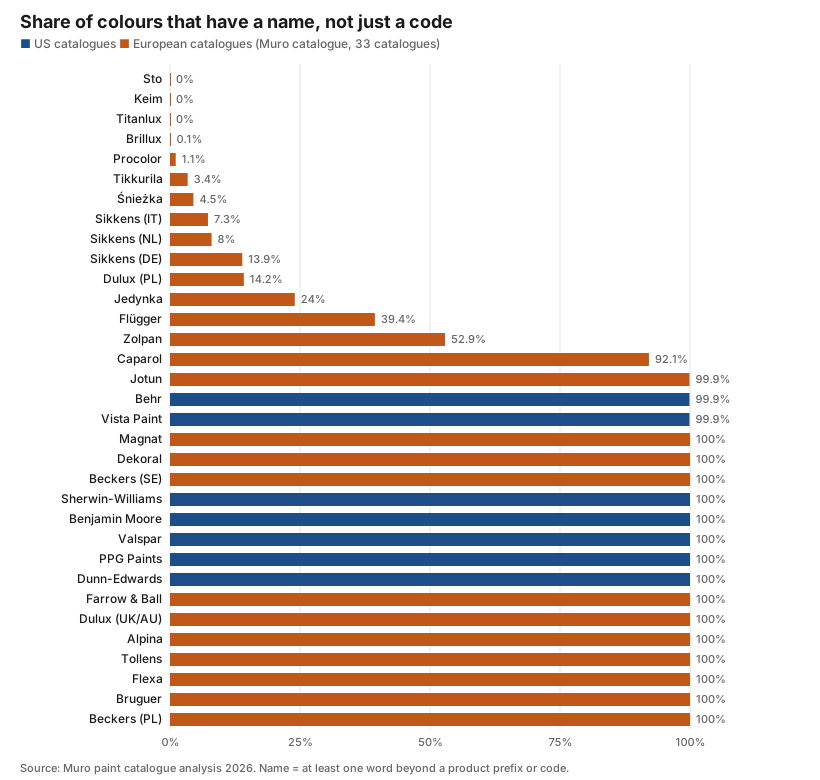
| Catalog | Colors | Code only |
|---|---|---|
| Sto (DACH) | 800 | 100% |
| Keim (DACH) | 264 | 100% |
| Titanlux (ES) | 4,101 | 100% |
| Brillux (DACH) | 1,514 | 99.9% |
| Procolor (ES) | 359 | 98.9% |
| Tikkurila (PL) | 3,319 | 96.6% |
| Śnieżka (PL) | 2,044 | 95.5% |
| Sikkens (IT) | 124 | 92.7% |
For a homeowner that matters: a code is what you order, but a name is what you can search for and remember.
5. Europe paints greyer, and whites are a catalog decision
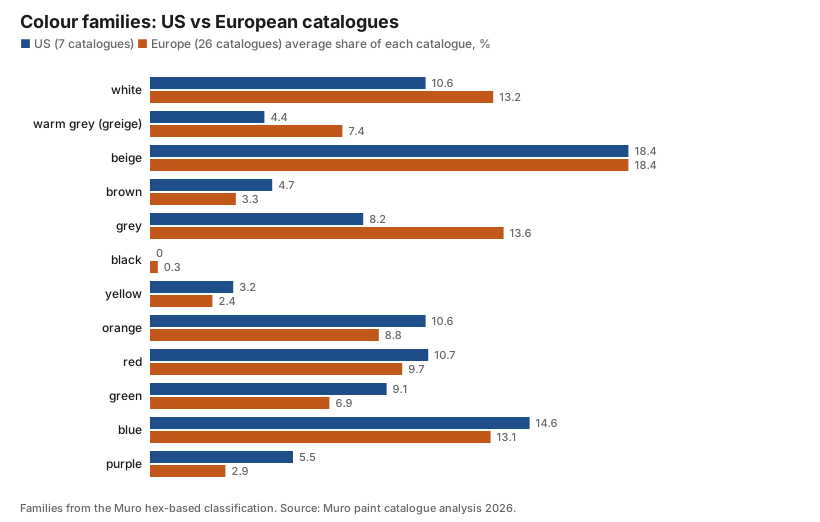
The averages hide a wide spread between catalogs. The share of whites ranges from 39% (Procolor) to 4% (Sikkens (IT)). Taken together, US and European catalogs have a similar share of whites (10.2% and 11%).
| Brand (market) | Colors | Share |
|---|---|---|
| Procolor (ES) | 359 | 39% |
| Magnat (PL) | 170 | 37.1% |
| Beckers (PL) | 189 | 22.2% |
| Beckers (SE) | 198 | 21.2% |
| Sikkens (DE) | 1,528 | 17.8% |
The greyest catalogs:
| Brand (market) | Colors | Share |
|---|---|---|
| Flügger (Nordics) | 1,392 | 23.7% |
| Dekoral (PL) | 324 | 22.8% |
| Beckers (PL) | 189 | 19% |
| Alpina (DACH) | 186 | 18.8% |
| Farrow & Ball (UK) | 132 | 17.4% |
Average family share per catalog (each catalog counts equally):
| Family | US | Europe |
|---|---|---|
| white | 10.6% | 13.2% |
| warm grey (greige) | 4.4% | 7.4% |
| beige | 18.4% | 18.4% |
| brown | 4.7% | 3.3% |
| grey | 8.2% | 13.6% |
| green | 9.1% | 6.9% |
| blue | 14.6% | 13.1% |
6. What paint names are made of
In the 18,353 named colors of the seven US catalogs and Farrow & Ball, the most common words are colors themselves. After that come food and nature.
| Word in the name | US colors | Share |
|---|---|---|
| blue | 692 | 3.8% |
| green | 630 | 3.4% |
| white | 419 | 2.3% |
| gray / grey | 393 | 2.1% |
| food (strict list) | 1,092 | 5.9% |
| nature and weather | 1,531 | 8.3% |
"Gray" is the standard spelling in these names: 366 colors use "gray" and 27 use "grey".
Methodology
- Source. The Muro catalog (
data/kolory), 35 catalog files and 52,970 rows, version of 2026-09-25. The numbers published for the Muro app (about 51,000 colors) are counted slightly differently: here we count unique name and hex per catalog. - What we count. 2,353 rows with the same name and hex inside one catalog are collapsed, leaving 50,617 entries. The RAL Classic standard (216 colors) is not a paint maker and is left out of every comparison between brands, so the study covers 50,401 colors from 30 brands. Percentage rankings use 33 catalogs of at least 100 colors (Schöner Wohnen, with 23, is left out of rankings).
- Catalogs, markets, companies. One brand can have several catalogs (for example Dulux UK and Dulux Poland, or Sikkens in the Netherlands, Germany and Italy). We treat each as its own catalog in rankings. For "same color at another company" we group catalogs of one maker, using shared names and codes, so a company never counts as its own twin: Dulux, Sikkens and Procolor are one group, Tollens and Zolpan another, and the Polish and Swedish Beckers a third. USA means the seven US catalogs; Europe means the other 26 (including Dulux UK/Australia and Tikkurila's Polish catalog).
- Colour difference. CIEDE2000 (ΔE00) computed from the hex values with the same function that powers the equivalents on every color page of usemuro.com. Under 1 is "practically identical" for the human eye, 1 to 2 "very close". Clusters are built around a reference color: every member is within the stated radius of it, and we report the largest gap between any two members.
- Hex values are screen approximations of real paint. They come from the digital catalog data we hold for each manufacturer, and a dried paint film will differ. Two paints with the same hex are not guaranteed to match on the wall.
- Colour families come from Muro's hex-based classification into twelve families (white, greige, beige, brown, grey, black, yellow, orange, red, green, blue, purple). It is based on lightness and chroma, so very pale tinted colors count as white.
- LRV (light reflectance value) is our own estimate computed from the hex, except for Brillux, Caparol and Keim, which publish their own. We label our figures as approximate.
- Names. A color counts as "named" if its name has at least one word of three or more letters beyond a short list of product prefixes. Word counts use the 18,353 named colors of seven US catalogs and Farrow & Ball. The food, nature and place lists are chosen by us and stored with the data; the "strict" food list leaves out words that are also color names (cream, orange, lime, olive, peach, plum, mint and a few others).
- Limits. This is an analysis of one catalog and says nothing about sales volumes. Some catalogs are fan decks designed for trade (Brillux, Sto, Keim), others consumer ranges, and size differs a lot (from 124 to 4,534 colors), so rankings by share favor small catalogs at the extremes.
- Reproducible. All figures come from
scripts/badanie/katalog-2026.ts, which writesdata/badanie/katalog-2026.json.
Citing this study
You may quote figures, tables and charts from this page. Please credit "Muro paint catalog study 2026" and link to this page.