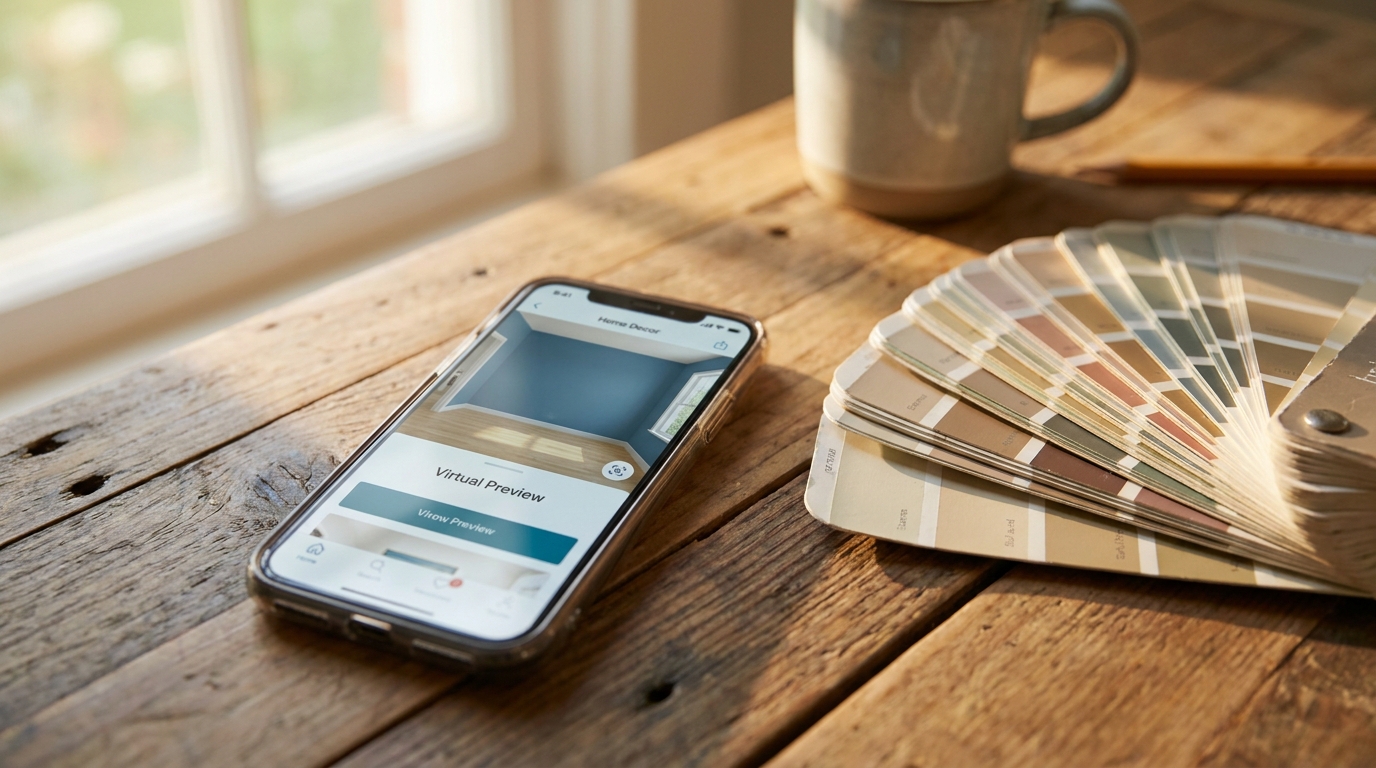
ColorSnap is free and backed by Sherwin-Williams. Muro costs money but covers every brand. The question isn't which app is "better" — it's whether brand lock-in matters to you.
I used both apps on the same room. Here's what I found.
Quick comparison
| Feature | Muro | ColorSnap Visualizer |
|---|---|---|
| Colors | 27,000+ from 14 brands | ~1,500 Sherwin-Williams only |
| Technology | AI photorealistic generation | AR overlay + brush tool |
| Price | Subscription | Free |
| Brands | SW, Benjamin Moore, Behr, Farrow & Ball, Caparol, and 9 more brands | Sherwin-Williams only |
| Result quality | Photorealistic — preserves lighting & shadows | Flat color tint — no lighting preservation |
| Batch mode | Yes — 12 colors at once | No |
| Color matching | From any photo → any brand | From photo → SW colors only |
| AR mode | No | Yes (Instant Paint) |
The honest case for ColorSnap
Let's start here. ColorSnap is genuinely useful for three things:
-
Browsing Sherwin-Williams colors. The digital fan deck is well-organized. You can browse by color family, explore curated palettes, and save favorites. As a catalog, it's great.
-
Quick AR preview. The Instant Paint AR feature lets you point your camera at a wall and see color in real time. It's not accurate — it's a flat overlay — but it gives you a gut reaction fast.
-
In-store convenience. The paint calculator, store locator, and ability to find color cards by location on the wall display are genuinely handy.
And it's free. No subscription, no credits, no strings.
Where ColorSnap falls short
You only see Sherwin-Williams
This is the big one. If you're choosing between Sherwin-Williams Agreeable Gray and Benjamin Moore Revere Pewter — two of the most popular greige colors — you can't compare them in the same app. You need two apps. And even then, the visualization quality differs between them, making comparison unreliable.
Muro has all of them. One app, one photo, every brand. One app, one photo, every brand.
The visualization is a flat color overlay
ColorSnap's "visualization" replaces your wall area with a flat, uniform color. No shadow preservation. No lighting variation. No texture. Your wall looks like someone used the fill tool in a photo editor.
This matters because paint looks dramatically different depending on light. A color that looks warm near the window might read completely different in a shadowed corner. ColorSnap shows neither — it shows one flat swatch on your wall.
Muro's AI generates a new image that accounts for the actual lighting in your room. The shadow behind the couch stays. The warm light from the window creates the natural gradient you'd see with real paint. It's the difference between a preview and a prediction.
No batch mode
Want to see 8 colors on your wall? With ColorSnap, that's 8 separate operations, manually switching colors each time. With Muro, select up to 12 colors and generate them all. Way faster when you're narrowing a shortlist.
When each app makes sense
Use ColorSnap if:
- You've already decided on Sherwin-Williams
- You just want to browse the catalog and save colors
- You need a quick AR gut check at the store
- Budget is zero — you want free
Use Muro if:
- You're comparing brands (SW vs BM vs Behr vs anything else)
- You want a realistic preview of how color interacts with your room's lighting
- You're narrowing 10+ options down to 2-3 finalists
- You're in Europe (ColorSnap doesn't have Caparol, Brillux, Farrow & Ball, etc.)
The cost question
Yes, Muro costs money. ColorSnap doesn't. But think about what you're actually saving by using a free app with inaccurate visualization:
One wrong color decision costs $50-200 in paint plus a weekend of repainting. If a more accurate preview prevents even one bad choice, the subscription pays for itself many times over.
That said, the smart play might be: use ColorSnap to browse and narrow to a color family for free, then use Muro to see your top 3-5 finalists with realistic lighting before you commit.
Bottom line
ColorSnap is a good free catalog for Sherwin-Williams colors. Muro is a better visualization tool for making the actual decision. They solve different problems — and honestly, using both makes the most sense for a lot of people.